By Evie Klein & Tyler Kliem
Boasting over 500 individual locations, New Jersey reigns supreme as the diner capital of the world. These eateries are characterized by giant portions, bitchy waitresses, and 24-hour service. Affordable and accessible, the humble diner is an emblem of constancy in a state of chaos.
We’re born-and-raised New Jerseyans, so diners have always been at our back door. In an era when diners are increasingly shuttering, we feel the diner deserves investigation and close appreciation in all its greasy glory. Although we grew up in different parts of the state, we share similar memories of Sunday morning pancakes and family dinners at our own local establishments.
We’re yearning. We’re hungry. And we’re going back to New Jersey.
At Summit Diner with Evie
Born and raised in The Sopranos homeland, I learned to despise its endless strip malls and superhighways. Civil disobedience was refusing to turn my skin spray-tan orange and the greatest thrill was leaving. After an adolescence spent despising New Jersey, I have little tolerance for hatred from out-of-staters, specifically regarding our institutions: the pizzeria, the bagel shop, and most importantly, the diner.
There’s always a cup of coffee waiting for you somewhere in New Jersey. The diner is the perfect setting for any occasion—lunch dates with grandma, funerals, weddings, and Sundays too lazy to open a fridge. During winter break, Summit Diner served as a meeting space for Tyler and me, the midpoint between our hometowns.
Before rushing out the door, Mom shouts at me to come back inside. A familiar sound from my childhood. She doesn’t want me looking like a mess to see my friend and takes it upon herself to button my shirt. Normally, I’d whine that I’m old enough to dress myself. This morning I decide to lean into nostalgia, allowing blue buttons to fall into her hands. I feel her tremor as she struggles to close each slit. She holds decades of life in the Garden State in her hands. Mom first left in the ‘70s to pursue her dreams of teaching, but returned to start a family. She claims she remained a Jersey girl the whole time. With patience, she closes the buttons, providing tips on avoiding traffic, warning me about the trickiness of parking at Summit, reminding me to call her so she knows I arrived safely.
On the way, I stop at a local gas station. The attendant calls me sweetheart as he fills my tank. He complains about customers who are doomsday-prepping for the snowstorm, believing it’s all baloney. I’m content someone else is pumping my gas.
Mom’s right: parking in Summit is a fucking nightmare. I give up on avoiding fees and park my ‘97 Volvo near the library. Tyler waits by the train station adjacent to our destination. He’s unmistakable: jeans, sweater, and a neon-yellow jacket. He looks like a human tennis ball.
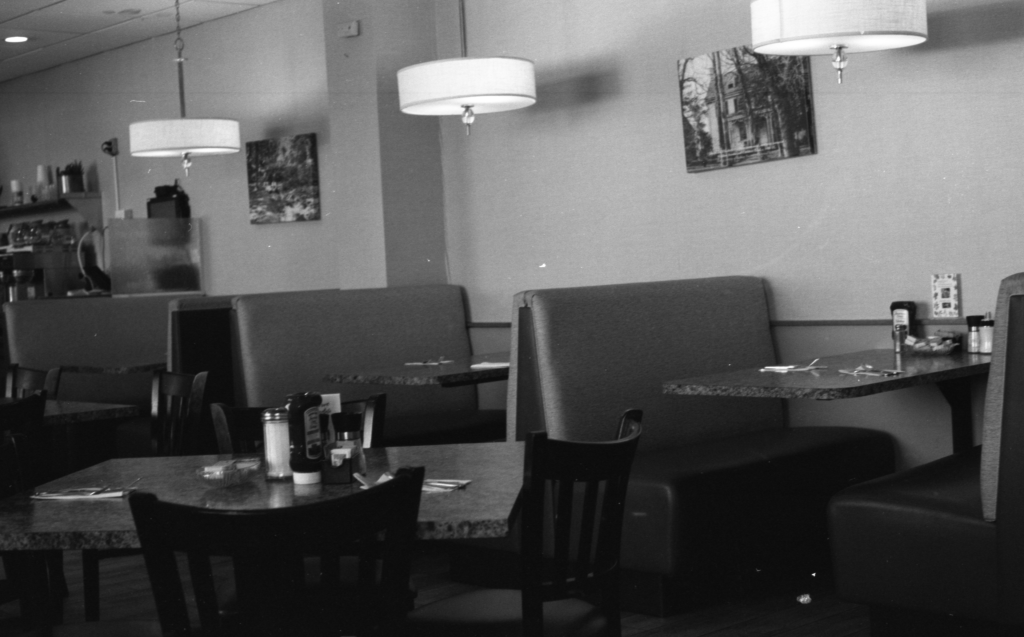
Since opening in 1929, Summit Diner has been a North Jersey institution. Wood-paneled walls and checkered floors are relics of the golden age of diners. Booths are packed on this snowy Saturday afternoon, so we sit at the counter. There are no menus, only a letterboard packed with the usuals. An open kitchen shows the balancing act of lunch service. Tyler orders scrambled eggs with bacon, pancakes, and OJ. I order my mom’s favorite: two fried eggs, hash browns, bacon, rye toast, and a cup of coffee to wash it all down.
Within minutes of ordering, the waitress makes our dreams reality. Tyler tells stories of his childhood in the state—one about the high school Italian teacher who once asked him why he chose German as his language class. He answered the teacher, “I wanted to learn the language of those who killed my ancestors.” Fortunately, the coffee is lukewarm because I almost did a spit-take.
This is a cash-only affair. We slip the cashier a $20 and tell her to keep the change, say goodbye to the sticky sweat of Summit Diner—their heater must have been cranked to the highest setting—and brave the cold.
A month later I return to that sacred space, this time with Mom by my side. This weekend I’m home for Dad’s birthday. As a present we let him sleep in. For the special occasion, she’s all dressed up, wearing an embroidered red beret to match her nails. We arrive early enough to secure a booth and immediately put in an order for coffee. Her mug is stained with pink lipstick, a familiar sight since childhood. Mom wants to hear gossip from school, so I spill juicy details over pancakes. A few stories in and she tells me I’m funny, then reminds me to lower my voice.
When she drops me off at the bus station, I know she’ll cry. I’ll remind her I bought round-trip tickets, slipping the extra pink NJ transit stub into my backpack. I already know I’ll be cashing it in sooner than I anticipate. But coming back is necessary when there’s no saying how many diner mornings we have left. The bittersweet part of leaving someone in New Jersey is there’s always a reason to return.
At Route 1 Diner with Tyler
There are only a handful of diners along New Jersey’s stretch of the 2,400-mile U.S. Route 1, but there is only one Route 1 Diner. On a school night, Evie and I take the train into Lawrenceville, just a 10-minute drive from my hometown.
I would’ve driven us myself, but my brother totaled our 2002 Chevrolet Malibu in the snow—the same day Evie and I visited Summit, barely surviving the slick of late winter. My dad drops us off, waving goodbye, his New York Yankees hat clad to his head.
Route 1 is a dinky building, its string lights and greasy vinyl countertops a gritty, self-made image of the New Jersey we’ve always known. There’s a certain comfort about the droning of cars as they whip down the highway, across from our tableside window. Suburbia never looked so uncompromising.
I could barely decipher the multi-page booklet that is Route 1’s menu, its kitschy word art and clunky graphics broadcasting all 100 variants of chicken dish. I am taken back to the menu of Edison Diner—on a more northward point of Route 1, where my mother grew up—with an amount of options rivaling The Cheesecake Factory, packed so tight it sacrifices all readability. I ate at Edison during the summer with my grandfather, who always orders eggplant parmesan to adhere to his kosher lifestyle.
The Jews have always reveled in New Jersey. My grandparents would bring my family to the delis and diners around Edison, where they still live in my mother’s childhood home. I remember the rained-in nights in elementary school when my parents would drag my brother and me to Harold’s New York Deli (confusingly, not in New York): the dill pickle bar and the stale muffins, the shareable stacks of pastrami and corned beef on rye, and the potato knishes basking in yellow mustard. I find so much of the diner in a kosher-style deli—its edges not so gleaming or glamorous, but the food and the people the most stripped-down joys of life.
Evie and I squabble about New Jersey things, being Jewish, our friends’ romantic entanglements, the diner. I tell her about the story of the Clarksville Diner which closed in 1988—once along New Jersey’s Route 1—now sitting, its entire facade, along the river Seine in Paris. I think about how nothing material is destined to remain, how age has destined anything physical for ruin. But these diners, our totems—they’ve brought us together, just as they did our parents and our grandparents. And the people before all of us.
The abrasive soul of New Jersey remains intact in the diner, even if it’s a vessel shelved to time. People, conversations, and the food in our bellies are all housed within those walls.
At Westmont Diner, with both of us
We begin our pilgrimage to the motherland by transferring from Philadelphia’s Market–Frankford Line to the PATCO Speedline, a rapid transit route that allows over 5 million riders to cross the border between Pennsylvania and New Jersey annually. Crossing the Delaware provides a priceless view of home that only costs $2.60.
Our destination is the Westmont Diner in Haddon Township, a South Jersey business recommended by a friend of Evie’s from nearby Tabernacle.
The longing instantly hits us when we cross state lines, passing cars donning the bright yellow license plates. We walk through a downtown reminiscent of anywhere in the state: a quaint coffee shop next to an Italian restaurant, two hair salons only separated by an olive oil company, an old-school barber shop across the street from another Italian restaurant. All sights familiar to any town in the Garden State.
Continuing past Krispy Kremes and Wawas, we run through sidewalk-less hills containing a Burger King, McDonald’s, and Tomar’s Discount Liquor, until our destination appears in the distance. With white walls and a bright roof, here lies our temple on the mound: giant red letters over the edifice reading ‘DINER.’ Another sign says ‘ALL BAKING DONE ON PREMISES’ in huge block letters and gives hope for the meal to come.
We’re greeted first by the executive chef, Scott Megna, wearing rayon pants printed with all kinds of citrus fruits. Tyler notices the Pall Malls in his shirt pocket and a Bic pen resting behind his ear. Once the personal chef for Aerosmith and a James Beard Foundation Award winner—the Grammy of the cooking world—Scott knows his stuff, and he seems to do it with a kind of Jerseyman swagger.
“I like creating. I like playing with food. I like making things different. I like making people say ‘holy shit’ when they get their plates,” Scott tells us.
The Westmont Diner was revitalized in 2021 by new owners Christos and Eirini Mentzas in the former location of the Crystal Lake Diner, which operated for more than 30 years before closing during the pandemic. Scott tells us that the back-of-house has made it its mission to reconceive traditional diner food. Want pancakes? You’ve got lots of flavors to choose from: orange creamsicle, Fruity Pebbles, and of course classic buttermilk. Looking for fine dining without the frills? Escargot and tuna tartare grace the menu too.
The legacy of Crystal Lake Diner still holds strong after its 30 years in business. Westmont waitress Tiffany Jones, a South Jersey lifer, recalls her own diner childhood in the building where she now works: “I had been coming to Crystal Lake when I was in high school, when you could smoke cigarettes at the table. There were jukeboxes.”
That was the image of the New Jersey diner that we grew up on—a perky establishment with old-fashioned gadgets to keep you busy—though we were born too late to witness this prime. Cigarette smoke among the chatter or Bruce Springsteen on the jukebox are all but a myth now. But even when covered with a fresh coat of paint, many old-school traditions of the diner still stand. Cups of coffee are replenished at the countertop and the fluorescent lights of the dessert display shine bright.
“We’re keeping the core values of a diner. But we also are trying to evolve it,” Scott says.
Competing with corporate chains and delivery apps, in 2023 alone 25 diners closed throughout New Jersey. Has the diner, then, become an institution that defines the state’s past, or is it a thing that needs innovation to keep it alive?
An archetype of the New Jersey diner is its impossibly long menu, and the Westmont Diner is no exception. The assortment of experimental and traditional food crowd enormous laminated pages. Breakfast or lunch? Sweet or savory? Here we face the ultimate conundrum of the diner: what to order.
Although tempted by its unconventional concoctions, we stay traditional. Our waitress, Evelyn, takes our order: two milkshakes (one chocolate, one vanilla), one salmon omelet, and an order of the “Perfect Pancakes.”
Evelyn, who’s worked at seven diners in the last seven years, isn’t a New Jersey native. Born and raised in South Philly, she used to work overnights at the Broad Street Diner—which has been slated for demolition since 2022—but was met with the exhaustion from rowdy Eagles fans and wasted patrons typical of the graveyard shift, letting her know it was time to leave. But Westmont has become her family. And she’s brought to Westmont the waitressing craft she’s been honing for so long.
“I bring a lot of Seinfeld references to my tables. Some people find it hilarious. And then some customers just kind of look at me like I have three heads,” Evelyn tells us. To her, the personal gratification of greeting a customer, even glibly, is all there is to it.
Scott echoes this sentiment, especially regarding his food frequenters. “Regulars have my phone number. And they call me whenever,” he says. “They’re family.”
We revel in this family for a moment while guzzling down milkshakes prepared by Evelyn. After a hectic morning shift, the diner is relatively calm by the late afternoon. Most patrons this time of day are seniors capitalizing on an early bird dinner special. A half-dozen balding men are in the corner of the restaurant, all behind their HP laptops in some sort of business meeting. Another waitress, with turquoise shell glasses, cradles a customer’s child near the butler doors. She hums along to Blondie’s “One Way or Another” which plays over the speakers as the youngest New Jerseyan in the establishment falls into a deep sleep to the lulling voice of lead singer Debbie Harry (also a Jersey girl, raised in Passaic County).
Our food arrives within 15 minutes of ordering. State expectation holds that diners must keep up with the rapid pace of New Jersey culture—there’s a certain rushed urgency, even in moments of relaxation.
Evie’s salmon omelet incorporates elements of another New Jersey staple: the lox bagel. Salty capers and lox mix with creamy goat-cheese, tempered by the home fries Evelyn recommended as a side. Tyler’s triple stack of pancakes, bathed in powdered sugar and garnished with an orange slice twist, verges more into decadence.
New Jersey pride runs through the diner’s veins, no matter where you go. “I’ve got a Jersey tattoo on the back of my leg,” Tiffany tells us. She pulls her leggings up to her knee so we can see. “I love my people. I love that we have four seasons. I love my gardens. I love my house. I love being 40 minutes from the crappiest beach in New Jersey, Atlantic City.”
We take the scenic route back to the train station, past Newton Creek in a local park. The only other pedestrian is a middle-aged jogger, singing loudly for all the ducks in the pond to hear. It’s “Hey Baby” by Bruce Channel from the movie Dirty Dancing. Evie begins singing along, confidently echoing the chorus and turning to a murmur when she’s unsure of the second verse. The jogger smiles at us as she blazes past across an intersection.
On the PATCO platform we reflect on our excursion—what adolescence in the state would have looked like if we met earlier in life. Tyler shows Evie a statistic, a probability: to be Jewish in the 2020s, and a New Jerseyan too, amounts to about 0.0002135% of the world population, give or take. Fate has taken us here, and we just so happen to exist in the same timeline as the New Jersey diner—a physical space that’s only brought us closer together and, of course, to the spirit of New Jersey.
The diner ecosystem—its collection of waitstaff, regulars, and everyone in between—welcomes all who find their way inside, just as it has welcomed us our entire lives.
“I fucking love this place,” Evie tells Tyler on our way out, “as much as I hate to love it.”
 The Woodlands