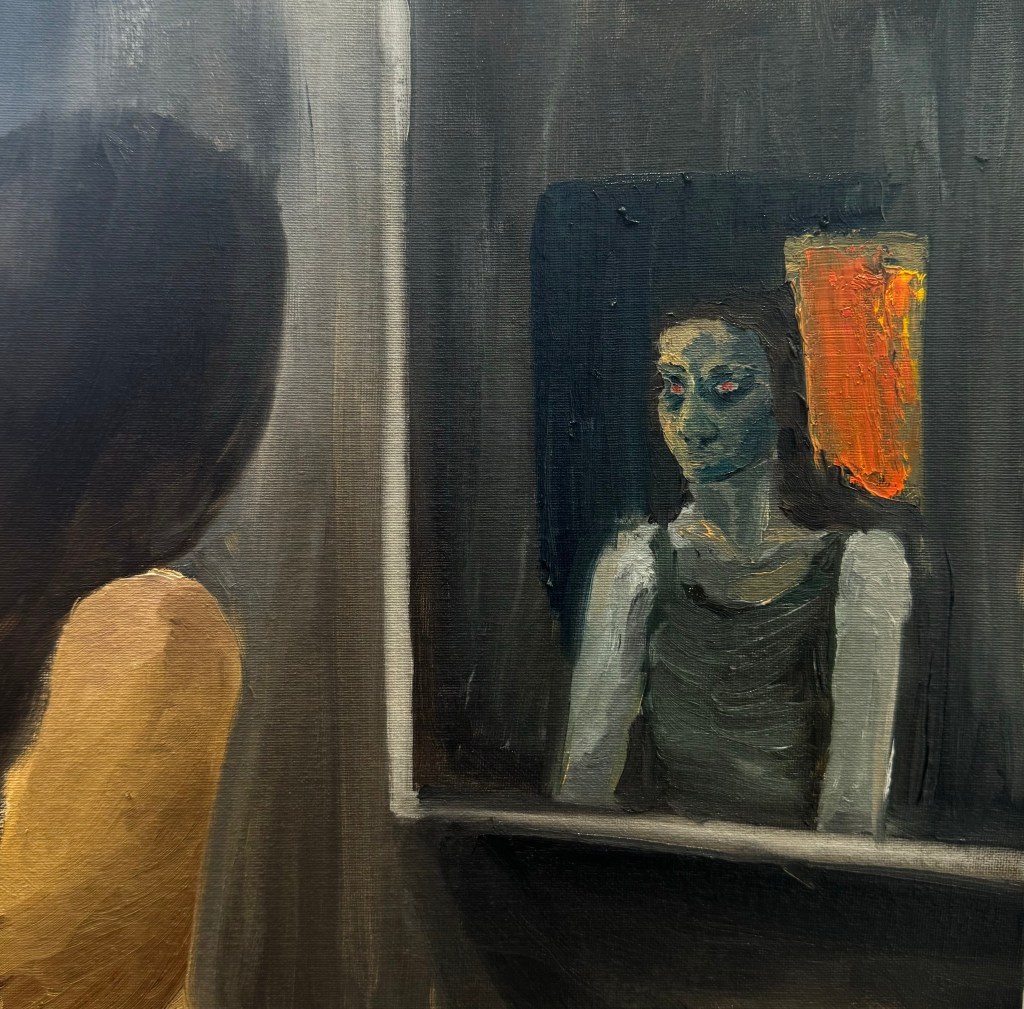
By Cathy Li | Artwork by Therese Jones
Anja doesn’t see her friends’ faces. When she does, she doesn’t focus on what they look like, but the feeling they give her. In my 11 pm anxiety, I ask her about my face. I think your face looks good altogether. People comment on your hair a lot. And makeup. But I don’t really…no, do you know what it is?
I don’t. I ruminate about our conversation after, when she is sound asleep, quiet to the world on my bedroom couch. I tiptoe into my bathroom and scrub my face clean with milky oil and cleansing balms. My face, an empty canvas, emerges from the suds and slick.
Face
Mirrors are everywhere: in window reflections, my phone camera, the Photo Booth app on my laptop. When I FaceTime Anja, I always peer into the lower right-hand corner—fixing my bangs, sweeping crust from the edges of my eyes, squinting and scrutinizing every single detail.
Three weeks ago, in a bed and breakfast in Gatwick, I did this and cried. I sobbed and sobbed until my face was a tortured mask I could take off and hang on a nail.
You have your mom’s face, Anja says. It’s not just that you have an interesting face, [your face] reveals your personality. People are not used to it, but they are open to it. I think it’s the cheekbones.
It’s true. I can’t look at my face without seeing glimpses of my mother’s. “You stole my face!” I tell her. “Mei-niu,” she says, “Beautiful girl, I look nothing like you.” A couple of years ago, she would say she hadn’t given birth to me, but rather she found me next to the garbage can in a dark alleyway. She looks away when my relatives compare us, when they call us sisters instead of mother and daughter. When I send her photos from college, she examines them closely, zooming in until I’m pixelated. “That doesn’t look like you,” she says.
Yet we’re spitting images of each other: freckled, olive-toned skin, beetle black eyes and of course, thin, sparse eyebrows. Our eyes glitter the same when we smile, like black diamonds winking, the space in between them equidistant. Photos of my mother in the 90s provide a preview of how I’ll look all grown up. In one of them she wears a black wool coat in Shanghai, hair slicked back with styling mousse and hairspray. In Philadelphia, I wear a different black wool coat that I thrifted my junior year of high school.
I’d like to imagine we’re even more similar than we really are.
Every Monday before class, I wade through the steps: sunscreen, makeup, perfume. Every flick and dab of product enhances a part of my face, fulfilling a desire to look more put together. I treat my eyes like a whole, my lips as another, and my face as the void backdropping everything else. With every spackle of rouge, with every line drawn and redrawn, my face grows less familiar, warping from a whole into a mere aesthetic. Sitting in front of the mirror, I do not think about the more important things—what I’ll eat later, what I’ll do the rest of the week, the person I’ll become in a year. I tightline my eyes with kohl instead, when really, I should be calling my mother.
I slather on my serums anyway and gua sha the fuck out of my face until it runs raw and moldable like clay. In total my skincare routine takes me about twenty minutes—my mother’s takes about ten. Her skin is smooth as a dolphin’s back, save for a couple wrinkles here and there. When I’m bare-faced, every blemish facing the air, she compliments me. She tells me I am pretty, pinches my nose (the same nose) and pushes a platter of fruit in my direction.
Sunscreen
A pimple the size of a small pea sits at the bridge of my nose. I shift uncomfortably, careful not to move too much under the bright lights as my skin is pressed, stretched, poked. Did you know that some children with a family history of acne can get it as early as the age of nine? My dermatologist did, I didn’t. She’s tall and skinny in her periwinkle lab coat, checking boxes for acne, rosacea, sensitive skin, brown spots. “Unfortunate. It’s my fault,” my mother says from the other side of the room. She shakes her head in disapproval so fast that her own freckles blur in the movement, as if they were trying to fly off her face.
Wear sunscreen, my dermatologist prescribes. At least SPF 50. It will help prevent scarring and more freckles as you grow older.
Eyebrows
At ten, I shaved off half of my left eyebrow in my sunny Brooklyn bathroom, where everything gleamed red and orange; every surface was coated in caramel glory. I’m not entirely sure why I did it. I already had thin, sparse Asian brows, just like my mother, who tattooed her arches as a remedy. Maybe it was to see if a razor could really plow through those stray hairs like it did on my arm, the metal teeth grating against raised pores and old scabs. Or maybe I was just bored.
My body opened up for the first time then. It was a queer feeling, fuzzy on the edges. I watched the follicles slip into the drain, some clumping together, some flaking off. It felt powerful. I could control the destiny of this body, this face, for the better. Things should be whole and last forever, but that’s not possible. We never have full control. The eyebrow grew back but not quite the way it was before. One day, it won’t be here at all. I won’t be here at all.
Eyes
I bought an eyebrow serum recently. When my mother found out I shaved my eyebrow, she was furious. “You used to have great eyebrows,” she muttered to herself in the kitchen. “They were your best feature.” Sometimes I catch her stealing glances at me, often making a snarky comment a moment later about my freckles—Should have worn more sunscreen!—or to rip apart my eye makeup—Too heavy!
When my mother was my age, she tattooed her eyebrows and waterline below her eyes. Around the same time, she went under the knife for blepharoplasty, a secret kept by the scars sleeping between her eyelids. If it weren’t for my father’s genes, I wonder if my face would have met the same fate, under bright lights, prodded with Westcott scissors and squeaky kerosene-blue gloves.
Instead, I stare into the mirror. So it goes: sunscreen, some sort of skin tint, eyebrow pencil, eyeliner, mascara, lip liner, blush and perfume. Every night I take it off, cleanse, stretch, nourish. Over and over again.
Sometimes I daydream about laying in bed next to a lover naked-faced, unapologetic. In a 4 am delirium we would talk, discuss the pieces of our lives that we have neglected, ruminate on our families, our losses, our hopes for the future. They would stretch out a hand past my face to tuck my hair behind my ears, look at me and see not only the bits and pieces as I do, but something greater. Something more, perhaps something whole.
I tell Anja about the amorphous lover of my dreams. She teaches me what limerence is, the state of overwhelming longing for emotional reciprocation from another human, who is perfect but unavailable. You always imagine things for what they could be, instead of what they are. Some things can’t have a conclusion. The way you see yourself is not permanent—your face will change.
I am always looking for myself. I am still trying.
In the mirror I imagine myself beyond the ambivalent symbol staring back at me, a reproduction of my mother, and both a thesis and antithesis of who I am and want to become. My face will decay. It is fallible. It will become and unbecome for the rest of time.
 The Woodlands