By Rosamund Lannin
Adoration
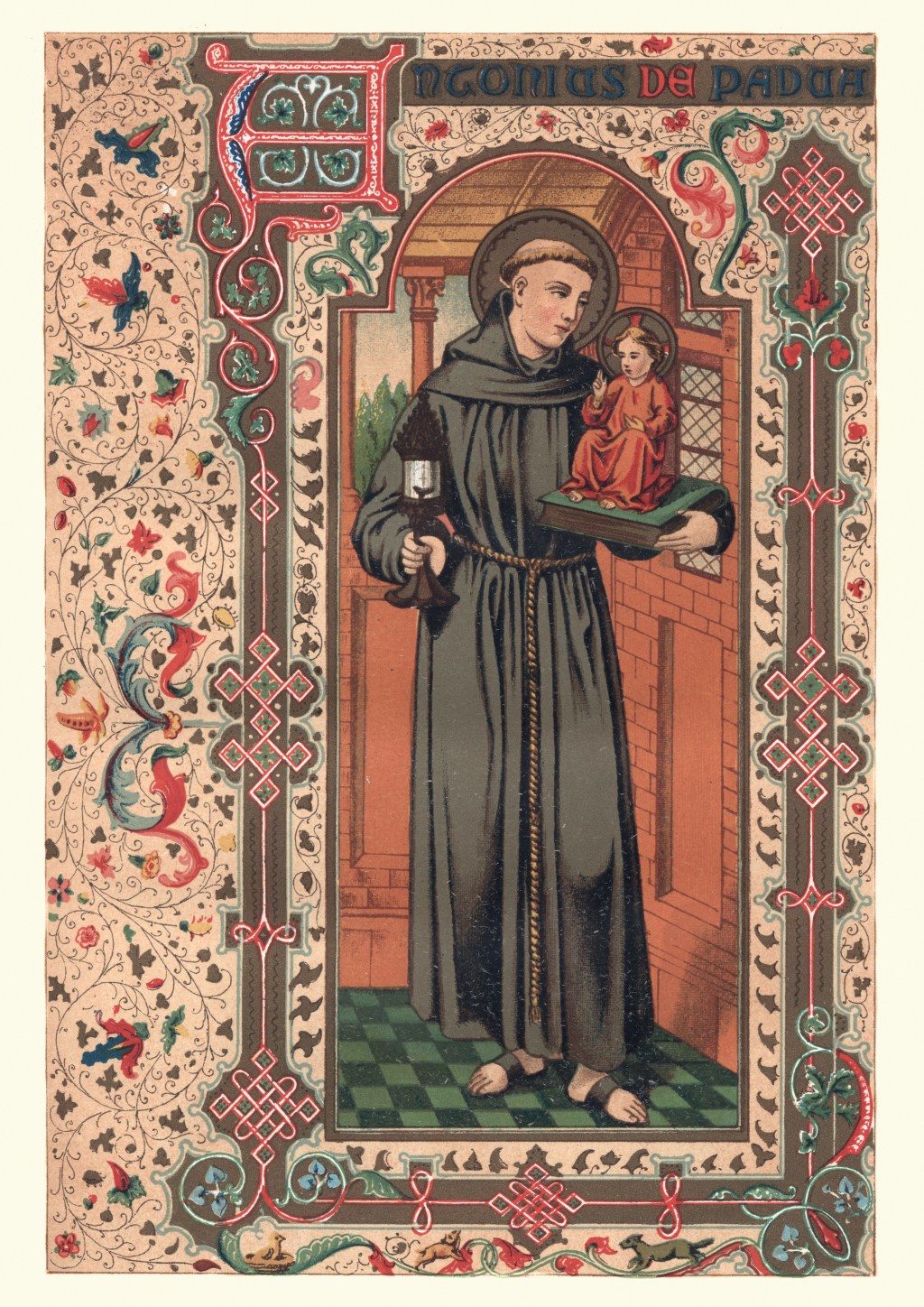
When I was a kid, I was over at a friend’s house when her mother lost a spool of red thread. “I’ll have to pray to St. Anthony for it to turn up,” she said, smiling as she touched the medallion around her neck. It was not strange to me that she prayed to a saint: my parents were Catholic and Jewish, as were most people we knew, except for my uncle in New York who was Muslim. Her devotion did not surprise me, but her smile did. In my house, we believed in things. You did not smile when something was lost.
My mother handled most matters of religion. When I came home from first grade with a plastic infant Christ child on a walnut shell, my mom burst out laughing: “Jesus on the half shell! It’s Jesus on the half shell!” Catholicism and Judaism could be funny. Losing things was not funny—it was sacrilege. This was unfortunate because I lost things all the damn time.
I was a nervous, dreamy kid, what I now recognize as generalized anxiety disorder. I often took journeys into my mind to escape, while my possessions went on journeys of their own. Hats and pencils and toys were always embarking on one-way quests, exiled to couch cushions or desk corners. It didn’t matter if an item’s value was time-sensitive or even urgent; the slim crevice behind a bus seat was a particularly satisfying place to tuck a thin, paper transfer. I caught hell for it every time; as much hell as my dad caught for forgetting to mail in my mom’s daycare licensing papers, disappearing for days at a time and not remembering where he had been, or being in the dark moods that I would later recognize as depression. Losing a bus transfer got me as much heat as my sister did for forgetting babysitting dates, talking back, or disagreeing with anything my mother said, ever. My mother’s anger and despair were explosive and democratic.
Repentance
In college, the religion of things continued to bring me pleasure—but the mental health tithe was very high. I had a good eye for thrift store finds, the patience to sift through piles, an intuition for what was interesting or pretty or cool. I liked buying gifts and was good at it. Strangers often asked me where I got my dresses. Out in the world, a love of things showed up as creativity and confidence. But my apartment was a mess. I was a mess. I stayed out and drank too much and did any drug I was offered and a few I wasn’t because it was fun, but also because I deeply hated coming back to my apartment, where I’d have to sit with my scattered thoughts and piles of clutter and, at my lowest, the ants that crept along my baseboards, carrying the crumbs I could barely bring myself to sweep because I drowned in shame every time I looked around. Sometimes I hit a wall and flew into frenzies of cleaning, purging my space of stuff I’d binged over weeks and months and years. It was a Sisyphean task—the clutter always came back. Calm and peace were ephemeral. Nothing good could last.
Until it could. Until it did. Somewhere amid my stormy affair with possessions, I began dating my now-husband. He was cute and funny and infinitely more exciting than a French lip balm. I came to love him more than anything—almost. When I lost my jacket or phone or book, the old faith rose back up, and he was eclipsed until I found it or passed out sobbing on the carpet, weak with devotion. He saw it all, the whole messy humiliating cycle: the mounting anxiety when I realized something was not there, the meltdown climax, the mumbling, guilty aftermath. He was concerned, but he didn’t walk away. He also saw my faith’s origin. When we drove up to visit my mom, who had continued to acquire things at a steady clip since I’d graduated, I made him park a block away so I could hyperventilate. I couldn’t bear for him to see it; I was afraid he’d turn around and drive back. When I was scared, I saw things in black and white, heaven and hell, evil and divine.
He didn’t turn around and drive back. He said he had relatives with houses like this and teased me about my “nerd cave” of a childhood bedroom. (There were more than a few Star Trek figurines.)
My rites felt different with a witness. My family religion started to feel more like a cult.
His patience created an environment conducive to curiosity, which paradoxically was harder than being told I was too much, as boyfriends had in the past: I had to sit with my thoughts. I began to wonder why losing something always hit me so hard. To condense years of work down into a sentence: I went back to therapy. I learned about hoarding and anxiety and ADD and felt seen. I wasn’t an irrevocably broken fuck-up: these qualities were part of who I was as a person and I could decide how to deal with them. I realized that healing wasn’t just about acquiring less but celebrating what you already had. A friend asked if I had liked growing up in a house with a ton of books, and I answered honestly, surprising myself: yes, a lot. It wasn’t about being a minimalist monk; it was knowing what mattered.
In therapy, I would confess my irrational fears. I was afraid I had left an appliance on, I was afraid the house would burn down while I was out, I was afraid I would kill our cat. Okay, she would say, and then what? I would struggle: And then…I would be really sad. It would be terrible. I would feel incredibly guilty. She’d prompt again: And then what? And I’d say: But I’d keep moving. It would suck and be terrible and take a very long time to get over. I would be heartbroken, but I would be okay, eventually, with time. I never noticed that my paranoid arson fantasies never featured any of my things. I knew in my soul that possessions weren’t sacred. It was just hard to make my heart believe it, to convince my body that it didn’t need to go into overdrive when a pen rolled under the couch.
We got married. Six months later, my husband was diagnosed with salivary gland cancer.
My husband had a tumor in his jaw. And then what? I called his parents. And then what? I sat next to our surgeon, who told me that the tumor was very likely malignant. And then what? My husband woke up from surgery and I realized I was going to have to tell him the news. And then what? I stood at his hospital bed, took a deep breath, and said the hardest thing I’d ever said in my life, all the while thinking Fuck you, Dr. Phillips. Just kidding, you were great outside of making me the messenger.
Thanksgiving
The difference between lost and found is sometimes very slim. In this case, it was wafer-thin, the width of a bus transfer. His Stage 3 tumor was millimeters away from healthy tissue. As he went through radiation treatments, I only cared about those millimeters. I didn’t care about anything I owned.
My husband has been in remission for just over five years. I often feel like I am in remission too. We have a daughter, a delightful and stubborn toddler who makes me think about what I want to pass on. It’s not things—or rather, possessions are not the important things.
I don’t like what it took to change. I don’t like that I still struggle; the urge to acquire and purge may never completely go away. But it’s quieter. And in its subdued state, I can see how much I love my people (and I love them, so much). I can see that possessions are just window dressing. They are no match for my family, as close as I’ll get to the divine. Spectacle, testicles, wallet, watch, lipstick, jacket, wedding ring, sock—I can misplace them all. What truly matters is never lost.
 The Woodlands