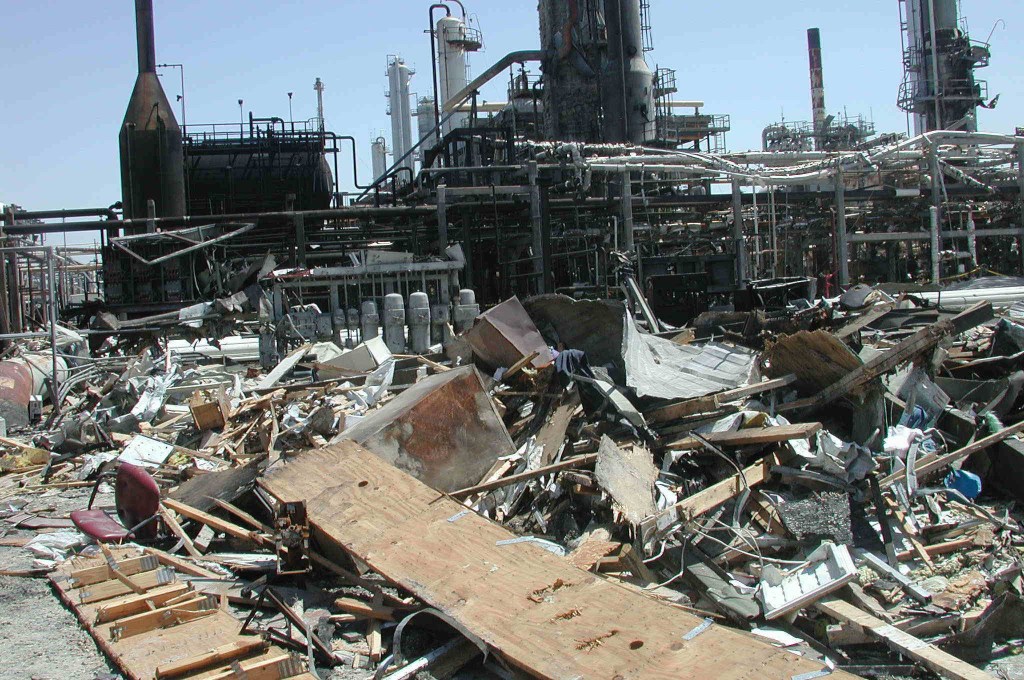
By Makenzie Kerneckel | Photo courtesy of CSB
At 1:20 p.m. on March 23, 2005 a geyser of toxic and highly flammable chemicals erupted within the confines of a sprawling industrial complex. A staggering 7,600 gallons of hydrocarbons claimed the lives of 15 people at the British Petroleum Refinery in Texas City, Texas. At the time, the refinery was British Petroleum’s largest in the nation with 1,800 employees spread over 1,200 acres. The site produced 460,000 barrels of crude oil a day. A spark from a passing pickup truck ignited a chain of explosions that afternoon, resulting in one of the most catastrophic oil refinery disasters in U.S. history.
In the heart of this colossal refinery, detonations obliterated nearby office trailers, claiming the lives of employees who found themselves trapped within. Almost two hundred workers faced injuries ranging from minor burns to life-altering trauma. The tragedy not only marred the physical landscape of the Texas City oil refinery but also exposed unsettling concerns among the workforce. According to a safety report released by the Telos group before the disaster, an “exceptional degree of fear” loomed among employees.
The following poem was built from a collection of interviews with men who worked at the Texas City oil refinery. The interviews can be found under the first section of the Telos safety report, entitled “Understanding Blame, Punishment, and a Just Culture.” The story of a chemical plant explosion on the coast of Texas in 2005 is not relevant anymore—except to those who remember.
However, this poem challenges journalistic death.
This poem commemorates the story of my great-grandfather who really did have a horse named Cupid that he rode to school every day.
This poem captures the unspoken story of my grandfather who has spent his life working up the ranks of the Texas oil industry.
This poem explores the story of blame in the aftermath of a deadly tragedy.
This poem follows the story of toxic masculinity and its march toward death.
But above all, this poem asks whether we are sure that death becomes irrelevant in accordance with the news cycle. Are we sure that our stories don’t deserve new life?
In 2004, then BP Texas City refinery manager Don Parus commissioned a workplace safety study by The Telos Group. The Telos Report was released to BP two months before the fatal explosions that killed 15 people.
— Galveston County Daily News
I

Q: Have you ever been hurt on the job?

A: No, I run like hell.
No, not sure if it is luck or skill.
Yes, told to get the job done, period, no ifs, ands, or buts.
Yes, if you do a lot of physical work you're going to get hurt.
In 1984, I got hit in the mouth and got 22 stitches.
Yes, lost part of a thumb.
Yes, received burn to leg.
Yes, sprained lower back.
Yes, keep it to myself.
No. But, I know someone who was.
Yes, always my fault, that's what management said.
Yes, lack of attention, rookie mistake.
Yes, they made me feel like a fool.
Yes, they made fun of me.
Yes, and they just wanted to find someone to blame.

II

Q: We need to know what it is really like—nothing held back.

A: I am a sour, malformed man,
temperamental and untrusting,
from snakebit Texas oil patches.
Cupid, was the name of my first horse,
what “stupid” sounds like on lips heavy
with tobacco dip.
Pa made me shoot Cupid,
said I got him sick, liar.
That’s when I learned blame. Blame
makes you a strange somebody, angry
at pieces of dust, scraps of the men
who tied your honor into limp knots.
I’ve been hurt so many times,
can’t remember who is to blame.
My wife kept an old legal pad,
with all of their names. Don’t know
where the damn thing is, she’s dead,
died at the refinery too, she wrote
in blue ink. Sometimes I wear her
wigs around the house, to remember
the rare sound of her laughter. When
I rip the hair off my head,
the bedroom grows silent. I cry,
for all the times she never did. Can’t
see well anymore, from the hot acid.
When I look in the mirror, can’t
find myself, can’t see all the scars,
only feel them, like promises, like hope.
The thing about blame is once someone
knows you’re good at taken it, it don’t
stop coming. It won’t.
 The Woodlands