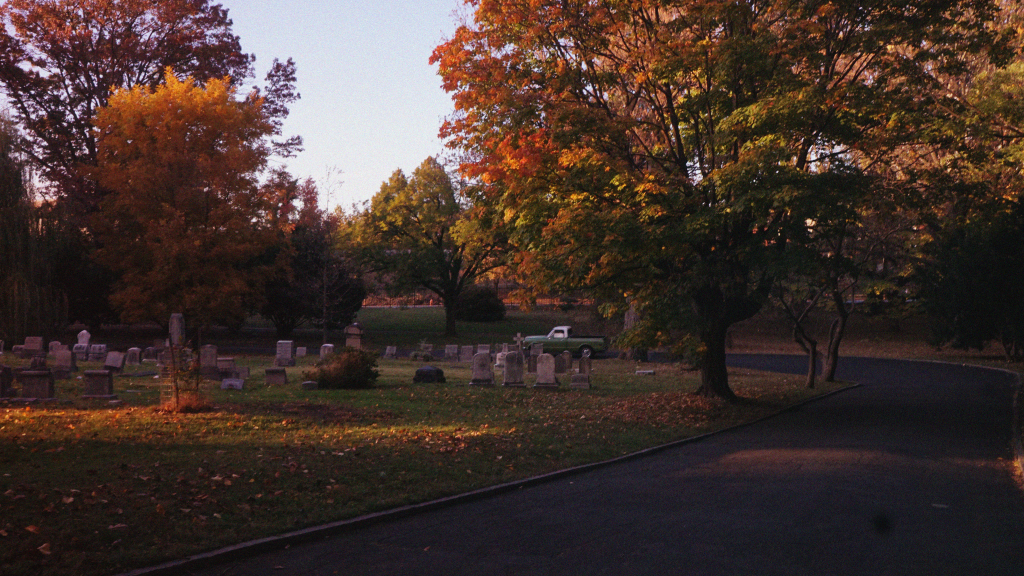
Interview by Armie Chardiet | Photos by Mira Sydow
This interview has been edited for length and clarity.
ARMIE CHARDIET: So I wanted to start at the beginning—how did you become interested in working at cemeteries, and The Woodlands specifically?
JESSICA BAUMERT: I have a degree in historic preservation. And when I was in school, I got an internship restoring headstones at a cemetery in Savannah, Georgia—which is where I went to school—called Colonial Park Cemetery. So I started working there. And that was kind of my introduction toward working in cemeteries. When I graduated from school, the person I was doing the internship for traveled around the Southeastern United States to cemeteries to work on them. I worked with him for a while, traveling to different cemeteries and working with them.
Then I moved to Philadelphia, and I worked in Fairmount Park for 10 years on historic buildings and sculptures. And while I worked there doing conservation work, I also worked at Christ’s Church burial ground to help restore it. It was in pretty bad shape and needed a lot of headstone repair before it could be open to the public. It was not open to the public at the time, and they wanted to open it to the public. So we did a pretty massive year long project restoring headstones and doing a bunch of other work there.
And then I saw that this job was available. I live in West Philadelphia, and I always thought this place was amazing and beautiful. But at the time, people weren’t really using the space for much. People would come here, but it was always kind of like, should I be here or not? It wasn’t the most welcoming place. I was like, ‘there’s so much potential with this place to be really a critical and important greenspace for West Philadelphia.’ Plus I had my cemetery background. And so then I got a
job here. And I’ve been here for 12 years.
CHARDIET: When did the renewal of the space begin? Were you one of the spearheaders of that, of that process?
BAUMERT: Yes.
CHARDIET: What did that initially look like?
BAUMERT: When I first got the job here, when I told my friends in West Philly that I was going to be here, a lot of my friends would be like, ‘Oh, I run there, is that okay?’ So a lot of the first stage was just changing our language around [the cemetery]. We’re open every day, from dawn to dusk. Like the things that we welcome people to do here, [we were] trying to make that more clear. It’s a little bit of a tricky balance, because there are some things that we don’t want people to do here that you might do in a normal city park space. So there’s a little bit more of a boundary.
But [we were] trying to just change that language, because when I started working here, there was a sign when you came in that basically said, ‘the gates closed at three o’clock; Don’t do this, don’t do this, don’t do this.’ So kind of shifting to be like, ‘we’re open every day, we want you to use the space, come see our trees, come learn about the people who are here now.’ So we were trying to start public programs to educate people about space. But also to just make that shift from ‘don’t do this’ to, ‘here’s how this space can be of value to the community.’
CHARDIET: So how do you see your role at The Woodlands in the last 12 years and in The Woodlands ecosystem, the history, and the way the cemetery is used today?
BAUMERT: Well, it’s interesting. I mean, this place has a lot of layers, you know. Before it was a cemetery, it was an estate. And there are remnants of an estate throughout all of the grounds. And so it’s kind of like, the more that I’ve learned about it, and the more research that’s done on the history of this place, the more of those layers you realize exist, which I think makes this place cooler. Things start to make more sense, you know, certain roads that have been here since the 18th century, that are now part of the cemetery road system, and kind of how the development of the cemetery came to be from an 18th century estate to where it is now.
CHARDIET: Could you also speak to your relationship with the cemetery on a personal level?
BAUMERT: I deal with the cemetery on many different levels. And one of the things that I think is healthy, and that not very many people have the experience to do, is to be faced with death every day, to walk in here every day and see the ‘time flies’ emblem on the front gates, and to go have a phone call that comes in somebody, you know, lost a loved one, and we meet with the family. And there are moments like that that are very sad. But it is very much a daily reality that I am faced with helping others through [death] on a regular basis. And I don’t think very many people in our society have that experience. And I think it’s actually a really grounding, healthy way to be able to think about this because it’s gonna happen to all of us. And a lot of people don’t think about it until that happens.
To wake up every day, even if you have something crappy happening in your life, to be like, ‘but I’m here, and I don’t know if I’ll be here tomorrow. So just try to make the most of it.’ And I think it feels like a luxury sometimes that I get to participate in this place in that way. And then there’s other programs that we do, like the grave gardeners. So we have over 100 volunteers that garden the cradle graves. And that’s been really cool, seeing other people also using the space to deal with grief in a positive way. Like the first ever work day that we had for grave gardeners, one of the gardeners was asked what she was thinking about while she was gardening. And she was like, ‘you know, I’m kind of thinking of my grandfather.’ And I’m thinking, ‘I’ve never visited my grandfather’s grave since he died. And he’s buried in upstate New York, and does anybody visit him?’ And so while she’s doing this, while she’s gardening the grave for a person, a complete stranger from the 19th century, she’s kind of connecting with a loved one in her own life that died. So there’s a lot of ways that involving people here, even if they don’t have anyone buried here, can get them to think about death or loss in a way that is—I think—a healthy way to think about it or to grieve.
CHARDIET: Yeah, this is where I came to process my grandfather’s passing. It was very therapeutic.
BAUMERT: Yeah, I think it’s very contemplative. Especially in the city. It’s like an easy escape. You can walk in the gates and feel like you’re in a different place very quickly. And I think that easy escape has huge value for thinking or for processing. And we’re just a different kind of space. Like you couldn’t have done the same thing at Clark Park. You could have gone there and it would have been more like, ‘oh, there’s a volleyball game’ but you can always find a quiet space here. To think and to reflect. So, yeah I love to hear that’s what you did when you found that out because I think it’s one of the ways we provide the most value for the community, by being that kind of space.
CHARDIET: How has The Woodlands Cemetery changed your perspective on life and death?
BAUMERT: Loss and dying is very different from what we do with the body and dying, right? Like I think because I have to deal with the technical side of death, sometimes, to me, that part doesn’t matter as much. People have different traditions and I have great respect for whatever people want to do. But for me personally, it has made me realize that I don’t care what happens to my body when I die. I think that I care about losing a person and how I will remember that person, or doing things in memory of someone, or smells that remind me of my grandmother. How do I remember them? What are the things I can do to keep them in my life, even though they’re not here anymore?
I think of what happens to the body when we die. Personally, I think more like: ‘now we have to deal with what to do with this body.’ I think that just dealing with the technicality of that, and thinking a lot about things like green burial and cremation versus full body burial. And because I work here, it’s become more of: these are the options and I wish there were other options, but there aren’t, and I can’t do anything about that right now. And environmentally, are these options good? And then sometimes with the cemetery, as somebody that runs a cemetery, I think to myself, this is a really— in modern day terms, in the middle of the city—a really bad use of land, right? There has to be a more efficient way for us to do this, because a lot of cemeteries are full, they’re used for nothing else. And then when they’re full, then what?
So one of the things we’ve really tried to do here is make sure we do have areas that have never been [used for burial], and to make sure that they stay unburied. So that, even when the cemetery space is full, or hopefully, when the industry changes, we will always have open space, we will always have the running path, making sure that the things that are not cemetery don’t turn into cemetery. Because if the whole site was just buried, it’s extremely limiting on what we can be in the future, and our ability to exist into the future. So it’s a balance that has to be found.
I just feel like I know too much about what happens to the body when you die. And to me, the more important thing is ‘how do I remember this person?’ And for some people, remembering a person is to have a place for them to go to visit that person regularly. And in our situation, one of the things that I think is really special about this place now is a lot of the people being buried here, live in the neighborhood, or will have their grandmother and their daughter and grandkids that come here all the time together. And they’ll buy a space here because when they die, their grandkids have fond memories of being here with them. So they’re still very much living when they buy their space, but they’re buying a space here. Not because we’re a cemetery, as much as it is that they had a life here, and their grandkids have memories of being alive here. And so they will come here and have fond memories of their grandmother by visiting here—a place that they had a lot of fun. So that is one of the things that I think has been one of the most gratifying: to see how people have started using this space and how that has started to translate into ‘well this is where I want to be for eternity because of the life that I was able to have here.’
The Woodlands Magazine is not affiliated nor sponsored by The Woodlands cemetery.
 The Woodlands