By Connor Nakamura | Photos courtesy of the Bancroft Library at the University of California
Hidden in the lists of Japanese names, WWII internment camps, and congressional legislation in Densho Encyclopedia, I spotted an orange hyper-linked title—Philadelphia Hostel. Curious, I clicked and skimmed the short article. I read that the Hostel was “set up in Philadelphia for Japanese Americans leaving the concentration camps,” and was the “longest running of the hostels outside the West Coast.” An image from the hostel shows a group of women sharing a plate of cookies in the living room.
Being a recent Philadelphian and lifelong Japanese American, the article immediately intrigued me. Philadelphia is not a place typically associated with Japanese American history, which is overwhelmingly centered around California and Hawaii. So I read each section with more intention until I encountered these words in the second paragraph—“The Philadelphia Hostel was located at 3228 Chestnut Street.”
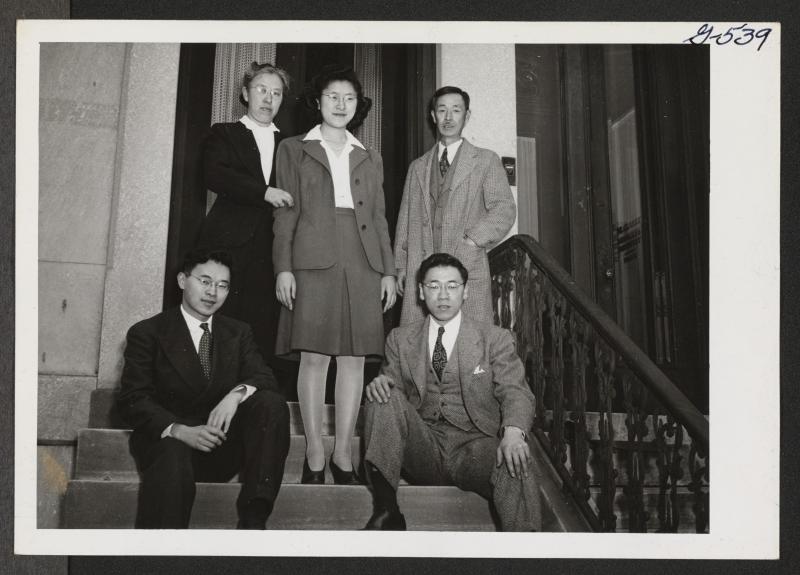
Stunned, I pulled away from my computer. The Philadelphia Hostel was a mere two blocks off of University of Pennsylvania’s campus. As a history major with a keen interest in learning about my ethnic community, I was distressed for never having encountered this piece of history, assuming that very few signs of Japanese American identity existed here. I clicked through the references at the bottom of the article, learning about Mr. Saburo and Mrs. Michiyo Inouye, who ran the hostel and whose children attended Swarthmore College. The pamphlet included a map placing a drawing of the hostel close to 30th Street Station, and a representation of the Schuylkill River indicated in strewn out letters.
This small slice of history was a revelation. The hostel represented Japanese Americans’ efforts to reintegrate into a society that excluded them. I felt pride in that history.
However, I also felt uneasy in my pride toward the hostel—a building demolished decades ago. Why was I clutching to this monument from the past? Is there something about the Japanese American experience that lends itself to emphasizing history rather than the present?
For Japanese Americans, there is sometimes an ambiguous relationship to their ethnic heritage. Many Japanese families immigrated to the United States more than 100 years ago, a marked difference from other waves of Asian American groups (a majority of whom arrived after 1965). Current 4th, 5th, and 6th generation Japanese Americans hold only a distant connection to “Japanese culture,” often feeling alienated from the ever-popular food, anime, language, and music of Japan.
Despite this lack of connection to Japan, many Japanese Americans take pride in their unique identity, often tied to their ancestors’ perseverance in an era of extreme anti-Asian racism. In particular, incarceration (internment) during WWII touched the lives of many Japanese American families; these stories are still researched and retold today.
This reckoning with Japanese American identity feels all the more relevant on the East Coast, where there are no Japantowns and few monuments related to Japanese American heritage. In Philadelphia, the famous Shofuso House and yearly Cherry Blossom Festival in Fairmount park serve as some of the only reminders of a Japanese American presence.
While there are few physical monuments in Philadelphia, there is a sense of shared experience when I talk to 4th and 5th generation Japanese Americans at Penn. Because of the patterns of Japanese immigration, our family histories align, and we often hear similar stories from our older relatives.
I met Holly Shimabukuro in a sociology class. She noticed my last name and asked if I was Japanese. Out of pure instinct, I qualified that I was not “really Japanese,” and explained that my family had immigrated over 100 years ago. But she began to describe her family’s history and I realized our families shared similar experiences.
She asked me about my family’s incarceration experience during WWII. While it may seem morbid to talk about such a traumatic historical experience so soon after meeting, we talked about it with relative ease. I told her about my grandparents being interned at Poston and Amache, and she told me about her grandmother at Heart Mountain. During a later conversation, she explains that her family speaks openly about the incarceration experience, and that her grandfather contributed to the opening of Heart Mountain Museum, a place that strives to “historicize” the internment experience..
The memory of incarceration is a continuing source of unity for young Japanese Americans, serving as an experience that has defined numerous family histories. Holly tells me, “since my family was involved with internment, family history is really important.” This collective memory ignites a certain urgency for preserving Japanese American history. Keeping these stories of struggle and resistance alive remains a key goal for many Japanese American organizations.
Centering the internment experience remains a way of qualifying one’s experiences as an “assimilated” minority, and pointing to structural causes in history that have shaped the contemporary Japanese American. It is a way of recognizing, in the words of sociologist Jere Takahashi, the condition of being “forced to assimilate under conditions very much contrary to the wishes of the group members themselves.”
Our assimilation meant a loss of Japanese language. Holly tells me that among “even the older generation, it’s all English.” Language is a key avenue in which many Asian Americans understand their family’s culture, but that pathway has long been extinguished for Japanese American families.
Certainly there is an interest among young people to learn Japanese, with Holly telling me that her cousins used “Rosetta Stone or Duolingo courses to learn Japanese.” No one has spoken Japanese in my family since my great-grandmother’s passing, yet I had a similar urge to learn the language. When I took two years of Japanese at Penn, I joked to my friends that I was only taking Japanese because of “pressure from my dead ancestors.”
Because of the loss of language and adoption of American traditions, Japanese culture can sometimes feel like a foreign product to Japanese Americans. The intense popularity of Japanese anime, literature, etc. compounds this feeling of alienation.

This was a question I interrogated during the pandemic in 2021, where I felt especially isolated and unable to gather with the Japanese American community in my hometown of San Francisco. As someone interested in questions of identity and existence, I naturally turned to philosophy. A friend recommended Frantz Fanon, a philosopher intimately familiar with questions of assimilation. In his masterpiece Black Skin, White Masks, he addresses fellow Black intellectuals, but his message holds relevance to any minority group contending with Western society.
Fanon argues that holding on to a particular “historical narrative” damages the psyche, as it traps individuals in a “terrain already mapped out.” He warns people of color not to construct shallow connections with the struggle of their “ancestors” in order to justify their existence in a world that may not be of their preferred circumstances. In the conclusion Fanon proclaims, “the density of History determines none of my acts. I am my own foundation.”
This dispelling of the past and focus on the present was a refreshing take on culture and heritage that solved some of my personal questions about alienation. Rather than bemoan how Japanese Americans were more assimilated than recent immigrants (a sociological fact), I sought to become “my own foundation.”
Reading Fanon undoubtedly helped me feel more at ease with my present-day identity. But it is difficult to accept that Japanese American culture is squarely in the past, when symbols of Japanese American heritage continue to disappear. I remember being in Philadelphia when I heard that San Francisco’s Benkyodo’s mochi shop was closing—one of the few surviving stores founded before WWII. Even the few tangible monuments of Japanese American heritage in the remaining Japantowns did not withstand the pressures of time.
While physical monuments of Japanese American history disappear, stories and memories remain. Relaying family history remains crucial for young Japanese Americans who want to better understand their place in American history.
Holly tells me about her uncle, who served in the all-Japanese American 442nd regiment during WWII. Young Japanese American men volunteered to fight for their country despite being held in incarceration centers. Her uncle was willing to share his experiences, and Holly recounts the, “separate occasions he came to speak in my elementary school about WWII experiences.”
In this way, Japanese Americans have the privilege of intersecting with monumental events of American history in incredibly visceral and personal ways. When learning about the Philadelphia Hostel, I found that the Inouyes had little choice in moving from Tule Lake Concentration Camp to Philadelphia—being barred from returning to their native Sacramento. Nonetheless, the couples dedicated their lives to helping fellow Japanese Americans during a crucial transitional period. In late 1944 to 1945, the Inouyes hosted 1,148 people in their hostel.
It is astounding to learn about the diversity of people whose lives intersected with the Inouyes. Michiko Inouye served as an external liaison, working with religious and community organizations that supported the hostels. She undoubtedly worked with the Philadelphia Federation of Churches, the Women’s International League for Peace and Freedom, and the Citizens Cooperating Committee that supported the Hostel. Despite widespread anti-Japanese sentiments, she was elected a member of the Women’s Club of Woodland Presbyterian Church on 42nd Street, extending her reach beyond the Japanese American community.

The Japanese side of Kenji Moriuchi’s family was incarcerated in Arkansas, and moved to New Jersey to start an orchard after the war. He is another Japanese American I met at Penn who has shared his experiences keeping his Japanese identity within his family alive.
Despite also identifying as Cuban, white, and Chinese, Kenji has learned a lot about his Japanese American heritage. His grandparents still live in New Jersey, and he frequently visits for New Years and other family gatherings. “I have talked to my grandpa a little bit about it, but my grandmother mostly—even though she’s not a Japanese woman,” he tells me. From his white grandmother, he learned about his family’s experiences adjusting to life on the East Coast, where, “the Quakers actually helped him secure his first loan to buy a tractor, and at a time when it was very hard for Japanese Americans to get loans from the bank.”
While incarceration remains the key turning point in any Japanese American family history, the experience of re-adjusting to American society after the war is often what is most salient for young Japanese Americans. My grandparents were young children when they were interned, and spent most of their childhood in post-war Chicago. My grandfather tells me about playing baseball on his high school team, and claims to be the first Japanese American varsity player in the Chicago area. He tells me about attending a Japanese Christian church as a child, and describes the teriyaki and sushi that his mom cooked.
Kenji’s grandparents were born after WWII. He does not have any direct stories about internment from his grandparents, but he expresses deep pride in his family’s efforts in adjusting to the East Coast after the war. He speaks fondly of how his family related to both Japanese and American culture. “It’s all relative,” he says, “but [it’s] the parts that you enjoy the most about both cultures and putting them into one—that’s what I associate with Japanese American culture.”
Holly’s relatives played central roles in promoting Japanese American culture and history on the East Coast. One of her uncles helped found the Washington DC Cherry Blossom Festival, and another uncle worked closely with Mike Masaoka, the head of the Japanese American Citizens League. “[It’s] something I’m proud to come from,” says Holly.
Kenji tells me about the cultural traditions that his family has passed down through the generations. He describes his family’s New Years celebration as a “huge spread of sushi, rice, and chirashi.” Japanese recipes are a key way his family has passed down cultural traditions, and he tells me he wants to continue celebrating New Years, and cooking family favorites like salmon teriyaki.
Holly similarly cherishes the cultural traditions in her family. In her family’s home she has a shrine where she offers food to her ancestors. When her family visits Los Angeles, they attend the Obon festival and she visits cemeteries with her family, which have become important vehicles for understanding her identity. Holly tells me, “my dad and my grandfather, […] tell us stories about when they moved to DC. The Japanese side of my family has such an interesting and rich history on the East Coast.”
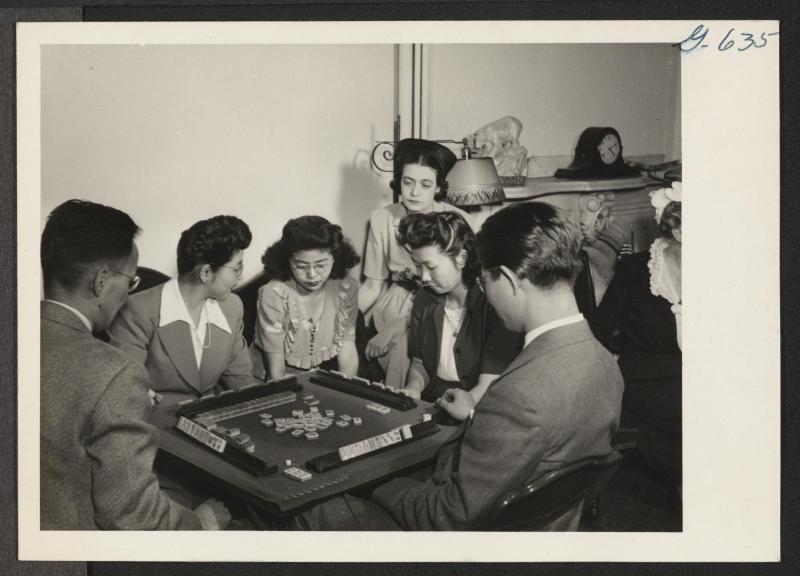
Gatherings were a key part of the Philadelphia Hostel experience. Cross-racial friendships were formed during numerous gatherings, shown by a picture of a white and Japanese audience in the living room listening to the “Dewey Wright Quintette.” Residents of the hostel played Japanese MahJong, pointing to the ways Japanese Americans kept their traditions alive after incarceration. People walked along the Schuylkill river and enjoyed cookies in the hostel dining room. Michiko Inouye served as the main cook, and her food provided comfort to those who may have been deprived of Japanese food during incarceration.
Gathering is a way for people to pass down culture, and Holly wants to pass down the same traditions her parents did. She emphasizes the importance of food, telling me, “My dad makes sushi. […] So that’s something I had him teach me too.”
Besides food, she wants to pass down the same stories about her internment and her family’s move to the East Coast. “My dad exposed me to all good and bad parts—both the atrocities as well as the culture. He’s always talked about internment,” she says. Because she was exposed to so many stories through her father, “I can be really proud of it and be interested in the topic and want to learn more,” she says. Holly wants to continue this tradition of storytelling, and hopes that future generations of Japanese Americans will be similarly curious about their place in American history.
“For my kids, I would want to [introduce them to] the things that I enjoyed, whether that’s food and meals we had as a family, or kid shows that I’ve watched, or Studio Ghibli movies,” says Kenji. Above all, he wants the next generation to have the freedom to connect with their cultural heritage. “Maybe it’ll inspire them to take Japanese or inspire them to do something more in depth with said heritage—but I think it’s more up to them to decide,” he says.
Today, Japanese Americans have the agency to decide individually whether they will learn about family history, or keep certain cultural traditions alive. Especially for young Japanese Americans on the East Coast, family plays the central role in transmitting stories and traditions. As visible landmarks like the Benkyodo Company fade from the three remaining Japantowns in the United States, many Japanese Americans will continue to confront deeper questions of heritage and family history.
These questions are not isolated to longtime Japanese American families. Many 2nd and 3rd generation Americans from immigrant families are unable to speak their parent’s native language, and fear losing connection with their cultural traditions. As America is on track to become a “majority minority” country by 2044, whole generations of young people will face a similar dilemma to Japanese Americans today.
History will become increasingly important to an aging “majority minority” population. “History is a lot easier to talk about, since it’s not as recent and trauma is less covered up. I feel like our generation is more open to looking into that history,” says Holly. And for Japanese Americans, there are plenty of resources to explore that history, with websites such as Densho and Discover Nikkei highlighting the stories of past generations.
The hostel may have served as a temporary home for Japanese Americans, but its legacy lived on far past the post-WWII period. The Inouyes continued the hostel as a residence for international students, who were arriving at Penn and Drexel in increasing numbers. The hostel later moved to 4238 Spruce Street, near the Woodland Presbyterian Church that Michiko Inouye regularly attended.
The original site of the Hostel suffered a tragic fate, being demolished due to urban renewal plans that displaced hundreds of West Philadelphia families. In the 1960s, Drexel constructed the James Creese Student Center on Chestnut Street between 32nd and 33rd. But the exact spot of the hostel would remain a grass lawn for nearly 50 years.
In 2013, a new building took the place of the grass lawn—the 8 story complex that hosts Shake Shack and Boba King. The story of the Inouyes is indiscernible under the glass and steel, which are a far cry from the original brick facade of the hostel.
But the Inouye’s legacy flourishes in the organizations that highlight the rich legacy of Japanese Americans on the East Coast, such as Densho or a recent exhibit by the Shofuso House that showcased the history of Japanese Americans in Philadelphia. And on an individual level, Japanese Americans who have much pride in their history carry on rich stories of struggle, accomplishment, and hope for the future.
 The Woodlands