By Meg Gladieux | Photos courtesy of Ken Gladieux and Tyler Kliem
“I like your shirt!” shouts a man in a wizard costume. We’re walking down Franklin Street toward the Ukrainian American Citizens Association, or The Ukie Club. “Thank you!” replies Tyler kindly, though I know the wizard was talking to me. I’m wearing my Sunshine Daydream t-shirt, a reference to the titular 1972 Grateful Dead concert documentary and live album, and a lyric to the coda of the song “Sugar Magnolia” and tagged onto the end of many other songs the Dead perform live. In the center, a vibrantly colored sun with the classic symbol of the Dead: the 13-point lightning bolt of the Steal Your Face emblem.
“Why’s he dressed as a wizard?” asks Evie from my other side. I don’t know. I wish I had an answer—Tyler and Evie have never seen Dead music performed live, and I’m supposed to be the expert here—my parents are Grateful Dead fans and I grew up on their music and culture. Sometimes though, it’s like I’m searching for life in a band that belongs to a different generation, clutching to the culture that was so enamoring to my parents, grasping for meaning in music that’s not quite mine.
Later, I’ll remember: before adopting the name the Grateful Dead, the band performed a few shows as “The Warlocks.” I’ll reason that the costume is a nod to that history—I notice two other wizards at the show that night. Or maybe it’s that it’s the weekend after Halloween—there are others dressed in costume at the show as well. Or maybe it’s a reference to some other Grateful Dead lore I don’t know about. Or maybe it’s just because it’s a Dead show. Does there need to be a reason?
For the uninitiated: The Grateful Dead was a cross-genre, experimental, psychedelic folk-rock band that started in 1965 in California, amassing a cult following of the long-skirted, pot-smoking, van-driving, hippie-type known as Deadheads. Multigenerational audiences across the ‘70s, ‘80s, and ‘90s followed them across the country, a cult of Deadheads who taped shows, cataloged setlists, collected shirts, pins, and other ephemera, and generally lived and breathed the Dead.
Tyler, Evie, and I are, of course, not here to see the Grateful Dead. The Grateful Dead played together for the last time at Soldier Field in Chicago on July 9, 1995. One month later, on August 9, lead guitarist Jerry Garcia (namesake of Ben & Jerry’s flavor Cherry Garcia, if that helps) died, and the Dead community would never be the same.
The band was founded by Bob Weir on guitar and vocals, Ron “Pigpen” McKernan on the keys (who died in 1972, and would be replaced by various keyboardists over the years), Phil Lesh on bass, Bill Kreutzmann on drums, and, of course, Jerry Garcia. They toured with Bob Dylan. They played Woodstock. New band members came and went. They broke up. They got back together.
But the Dead didn’t die—after Jerry died, they never would perform as the Grateful Dead again, but band members formed various iterations of spin-off bands: The Other Ones, The Dead, Phil Lesh & Friends, Further, many others. And the music lives on through recordings, memorabilia, storytelling, and the thousands of smaller local Dead tribute bands across the world.
Tonight we’re at The Ukie Club to see Friends of Jerry, one of the many Philly-area Dead cover bands. (Dreadful Dead, Splintered Sunshine, Jawn of The Dead, Box of Rain, Uncle Jawn’s Band, and Pure Jerry are a few of the other local Dead–scene staples.) What sets Friends of Jerry apart—none of the band members were ever actually alive to see Jerry play.
“We have been in many bands together over the years. And one thing that we always kind of shared was this love of the Dead,” says Kevin Paschall, Friends of Jerry’s drummer. It had always been a “pipe dream” for him and bandmate Sean Reilly (the band’s guitarist) to play the Dead’s music together. Kevin got into the Dead the way he imagines a lot of people do: “you have a stoner friend in high school who introduces you to a bunch of music and among those things is the Grateful Dead.” He loved the “ethos of improvisation” that defines the Dead’s performances and legacy.
“The Dead was a conduit to a lot of other things that I got into later like jazz, freeform improvisational music, and experimental music,” says Kevin. “I just [kept] finding these throughlines that related back to The Dead.”
Kevin and Sean have also long played in their own two-piece psychedelic band Brown Rainbow, which leans heavily into improvisation. They felt the Dead discography lent itself well to making the kind of music they loved while celebrating a band that meant so much to them. “We wanted to play the songs, but we wanted to do it in such a way where we weren’t regurgitating or being like a tribute band. We wanted to use them as vehicles for our own improvisation,” says Kevin.
In October of 2021, Kevin, Sean, and three other Deadhead friends got together to play a one-off show of Dead covers at the Attic Brewing Company in Germantown. It was electric and epic and cathartic and so much fun. “I just thought, oh cool, so, this is it. This is the band,” says Sean.
“I feel like I’m the newest to this music out of everybody,” says Danielle Zabielski, the band’s lead singer. She’s a new Deadhead—her introduction was dancing at Dead and Dead adjacent shows, starting around 2021. When she saw Friends of Jerry at that first Attic show, she knew she had to be a part of it. “So I was like, ‘Hey, you know if you need a singer.’” By their next show, in March 2022, she was on stage singing, “and it’s been a wild ride ever since.”
“[Ukie Club] is a really nice place to do what we do,” says Sean. Dead culture is so much more than the music, and Ukie Club, with its open space (it resembles a small gymnasium and reminds me vaguely of my local chapter of the American Legion) and large kitchen lends itself well to all the culture that comes with the Dead’s discography: the memorabilia, the dancing, the community.
Ukie is open to people “being in a certain state of mind,” says Sean—by which he means high. But the kind of joyful, carefree, communal high that comes with a bunch of tie-dyed strangers passing a joint on the curb between sets. “They’re cool with that [there],” says Sean. “Ukie Club rules—there’s room to boogie.”
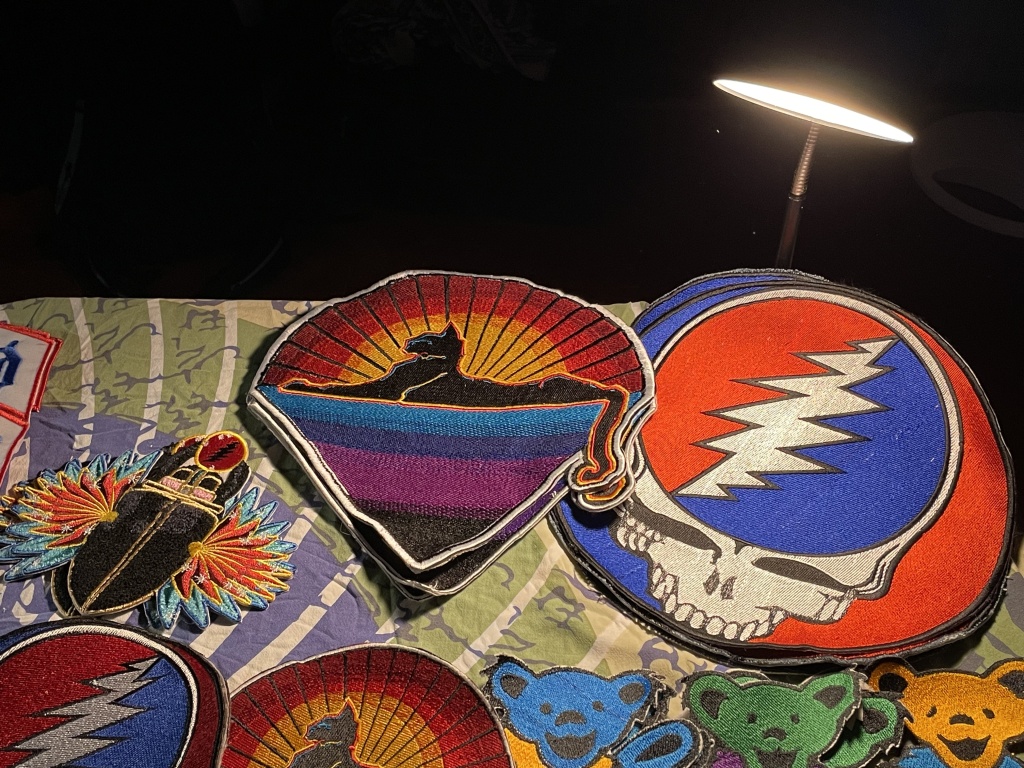
Along the wall at the Ukie Club, facing the bar, are racks of vintage t-shirts, many dating back to the ‘70s. Tables of stickers, enamel lapel pins, and patches display lyrics and the various symbols of the Dead: the The Steal Your Face skull (“Stealie”), dancing bears, terrapin turtles, and “Bertha,” the rose-crowned skeleton. In the back, Grateful Philly 215, a local barbecue vendor (of Deadheads, of course) is serving pulled pork and mac and cheese out of the Ukie Club kitchen.
“We have a lot of vendors that we know, food vendors, and people that want to be a part of this community aspect of it,” says Danielle. It’s a vestige of Deadhead culture of selling handmade artwork, usually unique to each show, sharing homemade food with fellow Deadheads, harkening back to “the classic lot, the classic Shakedown.”
Shakedown Street is the name for the community of vendors that started camping out in parking lots before Dead shows, selling all sorts of things—food and drink, jewelry, shirts, other random knick knacks, also named after the Dead song and album of the same name. Essentially, a tailgate for the Dead.
You can’t quite recreate Shakedown unless you’re at a stadium or large outdoor venue, but the space at Ukie Club does manage to facilitate the energy and maintain fidelity to the Shakedown tradition.
“At other venues we can sometimes display art,” says Kevin, “but they’re not down to have a bunch of people selling merch and whatnot.” Many of the vendors are tried-and-true Deadheads who are selling decades-old merch and memorabilia—the shirts and pins hold stories. Kevin recalls one show where one vendor had a shirt from the legendary 1977 Barden Hall Concert, when the Grateful Dead performed at Cornell. “It was a crew shirt, like for students who were working the event given by the university, not even the fan merch,” says Kevin. “I don’t know if he was selling it or if he just brought it to show it off.”
Friends of Jerry were aware that this sort of culture existed, but they’d never seen it “firsthand in such an intimate way,” explains Kevin. It was beautiful to see “how reverent people are preserving the culture of it all.” There are archivists of Dead history, curators of collections of patches, pins, and other ephemera. “Being a place for that has been incredibly special,” says Kevin.
At one point, Tyler says to me, “This is the most multigenerational event I’ve ever been to in Philadelphia.” While the majority of the crowd probably averages in their thirties, at the front, up close to the stage, white-haired couples that look to be in their sixties and seventies dance joyously; the rest of the audience clears space for them, a more gentle sway and groove falls over the more central crowd for most of the show. At the end of the first set, in the middle of “Dire Wolf,” Evie grabs my hand and we twirl.
“We’ve been lucky to have a pretty cool mix of older Deadheads that are coming out initially just to see a Dead tribute band. And then they’re pleasantly surprised to find that it’s something not quite so formulaic,” says Kevin. A lot of the Dead tribute scene tends to skew older, even more conservative, but Friends of Jerry have wider reach, especially to younger generations because of their roots in the experimental and DIY scene. While we’re there, we run into fellow friends of Friends of Jerry (and friends of The Woodlands!), Nate Garcia and Molly Dwyer, cartoon artists based in West Philadelphia, who are regulars of the Philly DIY scene.
“We get to use this music as a springboard into whatever happens. And for everyone that wants to go on that ride with us and see what happens, it’s so much fun,” says Sean. The older Deadheads, the sort in their tie-dyed robes, selling $50 vintage pins that have become staples of the commercial Dead aesthetic, are there for the music, but also to preserve the history, and of course hold a sort of pride over having actually seen the “true” Grateful Dead perform.
“I’m sure you’re aware of a certain type of older Deadhead that’s very protective,” Kevin tells me. I nod. “We’ve gotten a fair amount of folks being like, ‘You guys are called friends to Jerry. But you guys never even saw Jerry, man.’ And I like that kind of knucklehead energy. So I invite it.”
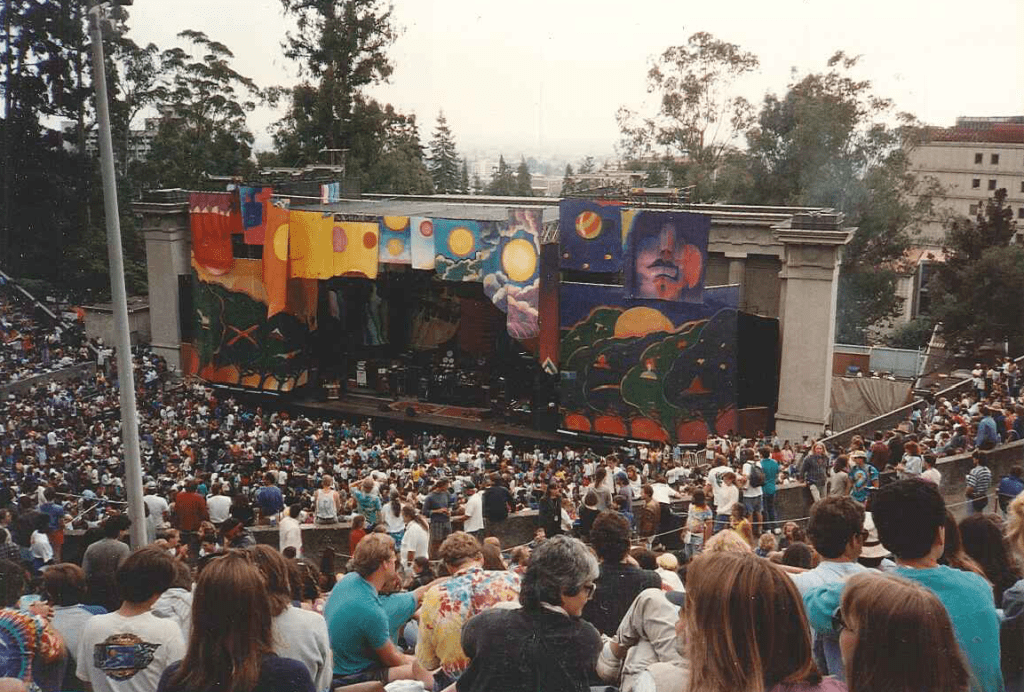
My parents could perhaps fall into that category of purist Deadheads, the ones who actually saw Jerry perform. They met playing pool at the Walnut Alley Bar in Shockoe Bottom in Richmond, Virginia, Labor Day weekend, 1995, just a few weeks after Jerry Garcia’s death. Ken, my dad, had just started medical school and Barb, my mom, was new to town. They were there with friends, but ended up playing pool, two-on-two. If my mom remembers right, she was wearing a Grateful Dead shirt, and of course my dad made a comment about it—maybe that was what drew him to her in the first place.
“I like your shirt,” he might have said. Perhaps they mourned Jerry’s death for a moment. Later, my mom remembers a Dead song started playing in the bar. “How many Dead shows have you been to?” Ken asked her. “Sixteen or seventeen,” she told him. I imagine a cocky little grin spreading across his face, as he told her he’d been to “over two hundred.”
At the end of the night, he got her number. They would get married and raise their children, my brother and me, on the Dead.
My father kept a binder of Grateful Dead tickets pressed in laminated sheets, documenting each and every Dead or Dead-adjacent show (Widespread Panic, Phish, Jerry Garcia Band, etc.) he went to. The walls of our home were covered in posters of skeletons, skulls, and rainbow-colored dancing bears. My father, a skilled guitarist, often played Dead songs on his guitar in the living room before dinner, our little family “jams.”
My favorite song my dad would play was “Monkey and the Engineer,” a lesser-known Grateful Dead song about “a tragedy narrowly averted,” as the Dead would introduce it at their live shows. The melody was easy enough for my little voice to sing, the lyrics easy enough for my little mind to remember. He’d strum chords and sing the little tune, “Once upon a time there was an engineer / drove a locomotive both far and near” and I’d sing along, “accompanied by a monkey who would sit on a stool / watching everything the engineer would do.”
When my father died in 2009, the Dead, their culture, their music, became a way to keep him alive. His old Dead tapes left exactly how he packed them, displayed next to his guitar like a shrine in our house. Well-loved Dead t-shirts, the best pajamas, treasured possessions, reciting a lyric, or putting on a Dead record in our house—the closest thing we could get to having him there with us.
I was 17 when I saw my first Dead show, at the Lockn’ festival in Nelson County, Virginia—of course, not the Grateful Dead, but Dead & Company, an all-star Dead spinoff band founded by original Grateful Dead members, Bob Weir on guitar and vocals and Mickey Hart and Bill Kreutzmann on drums; plus jam band favorites Oteil Burbridge on bass and percussion and Jeff Chimenti on the keys; and in Jerry Garcia’s place on guitar, John Mayer. (Yes, that John Mayer.)
When Dead & Company came together in 2015, 20 years after Jerry’s death, it was the closest you could get to a Dead renaissance. “It took me a while to warm up to John. John’s not Jerry,” my mom says. But now she’s seen Dead & Co. more than ten times, including their three-day “Final Tour” stint in San Francisco in July of 2023. “There are still people who’ve never heard the Dead but will hear them tomorrow and fall in love,” she tells me.
I saw Dead & Co. twice more after Lockn’: once with my brother in July 2022 in Philly at Citizens Bank Park, and again, with my mom on the Final Tour, in June of 2023, in Bristow, Virginia.
We tailgated and walked through Shakedown. We entered the stadium en masse with all the other tie-dyed bodies, and found a good space to sit on the grass. It was still light out when John Mayer’s guitar solo rang across the lawn for their opening rendition of “Here Comes Sunshine” as thousands of Deadheads danced and swayed, or just laid out on the lawn and soaked it in.
Halfway through the show, I walked through the crowd to explore, weaving through families sitting on the grass. I briefly danced along the “spinners”, who occupied a strip in the middle of the lawn space, arms outstretched, eyes shut, twirling and swaying in circles, uncaring who they bumped into, unquestionably alive. It’s a John Mayer cover of the Dead, but God, it’s the Dead.
Even before Jerry’s death, the Grateful Dead was always a cover band, the music living and breathing and changing with each performance. The spirit of jam bands, their improvisation, their experiment, means that the Dead, in all their iterations, were constantly remaking the music—it never stops, it never dies. The Grateful Dead was known to cover everything from old traditional folk standards to The Beatles. Friends of Jerry plays three covers of covers at the Ukie show—“Man Smart, (Woman Smarter),” “Good Lovin’,” and “Werewolves of London”—plus a cover of “L.A. Woman” by the Doors.
I wear my dad’s old denim jacket to the Friends of Jerry show, a lapel pin from the Dead & Co. Final Tour in Bristow show stuck into the collar, over my Sunshine Daydream shirt. Standing with friends in this space, feeling the Dead music flow through me, on the lawn in Bristow, or dancing on the wooden floors of Ukie, the music moving through all the molecules of me, made for this, a cascade of events from two people beside a pool table who fell in love through the Dead, to make me, here. I could be standing there, watching them meet, reaching through time to them, all unfolding to now. Maybe it’s the secondhand smoke making me feel a little high, or it’s just the music and all the people feeling it together, its kaleidoscopic, transcendent quality that just makes you feel that alive.
The community and collective identity of it all is really the way the Dead has stayed alive for so long. The life of local Dead subcultures—like the one in Philly—is evidence of the larger cult of the Dead. And the Friends of Jerry show is just a slice of it. “Seeing people come to our shows, and then meet each other at those shows, and then come back to more shows, and being like, ‘Hey, that’s my friend over there that I met at Friends of Jerry’—there’s nothing better than that,” says Danielle.
“We love this music,” says Sean, “people have a space to enjoy the music and have the culture around it with other people who feel the same way.”
Some of the long-time Deadheads that come to Friends of Jerry shows lean into preserving the customs of Dead shows, like taping. Dating back to the 70s, Deadheads would bring tape recorders to shows to produce their own recordings of the sets. “Taping is super cool because it’s very much like preserving—pun intended—a Dead tradition,” says Kevin. Friends of Jerry record all of their shows and put them on Bandcamp, but a few people still bring old-school recorders to their shows because of the importance of the tradition—and wanting to have a tape they made themselves.
In his days of Dead shows, my dad was one of those people: our basement is a resting place for boxes and boxes of his old tapes as well as CDs he burned from performances that were online. Because the Dead encouraged recording, their music was always open access—part of the reason they adopted such a cult following. While the Dead had the publishing rights for every song they wrote, they only loosely enforced copyright. The music was readily available, not just in their professionally recorded studio albums, but in their live form. The belief in sharing the music of the Dead far and wide was essential to the founding mentality of the band.
“We make the joke sometimes that this is what Jerry would have wanted,” says Kevin. “But I really do feel that way—I feel like Jerry would have wanted people to take this thing and make it their own, to inherit it and to channel it through all the different conduits of each of the players. That seemed to me what he was all about.”
The fact that Friends of Jerry has been so widely embraced by Deadheads new and old in the Philly area is a testament to the openness of the community to new interpretations of the music and acquiescence to influences—as long as they stay true to the ethos of the Dead. “We have Spotify, we can listen to everything, so much music all over the place,” says Sean. Unlike the days when tapes, radio, vinyl, and live shows were the only ways to hear the music, Spotify makes all their performances and studio recordings available in one place, as well as the interpretations of thousands of cover bands. The Dead is constantly in conversation with itself, taking on new life with every new listener, absorbing the micro influences of cross-genre interpretation.
“If only Jerry had Spotify,” says Kevin.
“Oh, if only Jerry had Spotify. He would love that shit,” says Sean.
As we’re waiting for the Uber after the Friends of Jerry show, we admire a yellow Volkswagen van with a Shakedown Street bumper sticker. The Deadheads file hazily out of the Ukie Club. On this little block of Franklin Street, it’s as if we’ve transplanted a crowd from the lawn of Soldier Field to the streets of Philadelphia. “I think I can smell, like, 40 strains of marijuana,” says Evie.
Yes, breathe it. It’s the smell of the Dead. “I think I get why people like this,” says Evie. There is something about being in it all, live, in the space, that has that effect on people, transcendence, collective effervescence, living and breathing the Dead.
“I’m going to be thinking about this for a long time,” says Tyler.
The last song Friends of Jerry played in their two-song encore was “Brokedown Palace,” which has always spoken to me as a song of grief and loss, but also rebirth, love, and celebration of life. It begins as it ends—
Fare you well, fare you well
I love you more than words can tell
Listen to the river sing sweet songs
To rock my soul
 The Woodlands