
By Meg Gladieux | Photos by Meg Gladieux
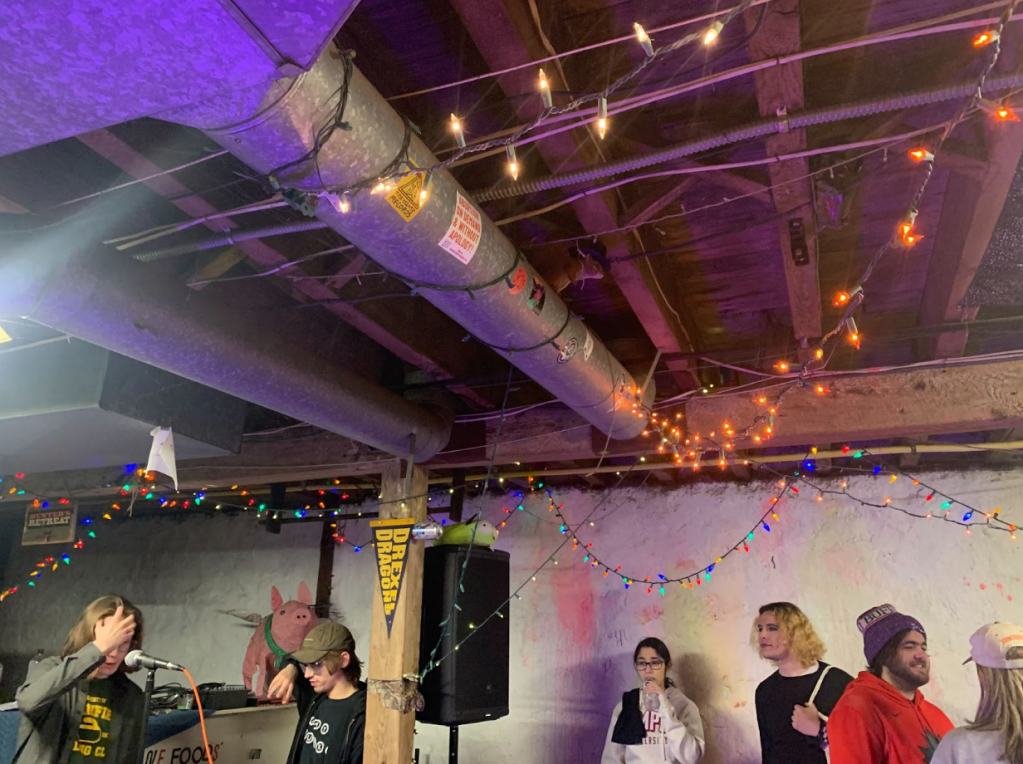
The concert roars at full force in the basement of Lucky Aide. Well, really, it’s a laundry room, fit with a washer-dryer in the back where the bands have their guitar cases and extra amps sprawled out. It’s a glorified half-finished bunker of sorts that doubles as a catch-all storage and supply space adorned with fairy lights. The stage is marked by amps at the far side of the room, an area rug, and Christmas lights fastened around the ceiling pipes.
You stand among 20 other people crowded in the open space amid the sticky clutter. It’s just one of the many “house shows” going on across the city, a scene that is rebuilding itself after years of live music being unsafe during the pandemic.
Lucky Aide—a “multipurpose art empowerment space” according to their Instagram bio—belongs to James and Jon, roommates, bandmates, best friends. You’ve seen them around at shows, but the first time you speak, you’re on Zoom.
“I just saw no better way than to just have shows in my own house and do them the way that I think they’re supposed to be run,” says James. He’s at home, 3410 Haverford Avenue, which this Friday will become Lucky Aide for a few brief hours when bands grace the basement. Jon sits in the stockroom at his work; he’s just finished his shift, and needs to head home soon for rehearsal.
James and Jon met in their freshman year at Drexel University and started going to shows, then quickly formed their own band, Mechanical Canine. They are punks to their core.
“The traditional music industry and traditional venues would not like to accommodate certain kinds of music and certain kinds of people,” says Jon.
A house show has all the excitement and mystery of the dark, cramped home of a stranger, loud, floor-shaking music, and collective effervescence of young people laughing, drinking, and dancing in fluorescent lights. It is the antithesis of the mainstream music industry—wholly committed to the DIY ethic and clutching to a certain reverence for the grunge rock alt-late-80s-early-90s creed of anti-establishment zines, iconoclast creed, Dr. Marten-or-Chuck-Taylor-clad mayhem, and joyous love of punk rock.
But wedged within that nostalgic rejection of the modern music landscape is the tangle of scene dynamics colored by the inevitability of social media and the still-coming-of-age, still-figuring-it-out members of Gen Z who define it. At shows, it’s all about who knows someone at the house. Who knows the bass player. Who has the most monthly listeners on Spotify. Who’s wearing the coolest outfit. Who knows the best show happening tomorrow night. Who will sell you a beer or let you take a hit from their Juul.
The houses range from serious venues with clearly marked signs, sober staff, established policies, and swift shifts between sets—how James and Jon like to run things—and completely makeshift chaos, where the bands become backdrop for the party, the euphoria of it all, no one in charge, no one in control.
While each house show venue has its own feel, there are certain commonalities among them all: they promote themselves mostly through Instagram, a week or two before a show promoting poster with the band line up, date and time. Doors at 7:30, music at 8. Their Instagram bios are elusive, a quirky inside joke to set the tone like Lucky Aide’s “Also a pharmacy,” maybe a brief nod to their Philly neighborhood, but always a short note to “DM for address” to find out the specific location of the show. They are nestled in houses on residential blocks, mostly near college campuses: Drexel, Temple, University of the Arts. Some places host a few shows a year, others, a few shows a month.
All are beautiful, loud, raucous, and—at times—terrifying.

James was always into music. A small town kid in Central Massachusetts, he found himself venturing into Boston to seek music. He was turned away—until he discovered the DIY scene. He spent his weekends in high school going to small emo and punk concerts. So when he moved to Philadelphia for college in 2017, he knew he wanted to find the same community here. “The whole thing kind of clicked to me,” he says.
He fell in love with the accessibility of the Philly scene, particularly that of Mantua neighborhood in Drexel’s backyard, which lives somewhat in the shadow of the success of the band Modern Baseball, a band of Drexel students who broke out of Philly basements circa 2012 and ended up making the Billboard Top 100. They are Philly’s great indie music success story—and the aspirational model for nearly every Philly-area college band playing the scene.
In fact, Lucky Aide is located down the block from what was once the famed “Michael Jordan House” where Modern Baseball used to play, so-called because the price of entry to see the bands on a show night was either $3 or a photo of Michael Jordan. It’s a strange sort of legend that haunts the concrete of Haverford Avenue, the same street where Lucky Aide and another venue, Luigi’s Mansion, now put on shows.
Jon grew up in Lincoln, Nebraska. “There’s not a lot to do there for the kids if they’re not into football. So born out of that, there’s this great all-ages scene in town,” he says. He started going to shows when he was 14. Upon his first year at Drexel, he immediately knew he wanted to embed himself in Philly DIY.
Bands play at house shows to increase their exposures in the scene. Between songs, they plug their SoundCloud and Spotify, tell you where they’re from, how they met—usually college, or even high school. After their set, bandmates sell merch in the living room of the house—t-shirts, buttons, stickers, CDs. What’s more attractive to grassroots bands, you don’t need a reputation to play a house show like you would at a typical gig in the city at a restaurant or bar. It’s a direct market to music lovers with an emphasis on live performance and community.
Like Lucky Aide, most DIY venues are run by men in their mid-twenties—probably roommates who live in the house and have decided to host occasional concerts for one reason or another. That being said, female and queer-owed venues are becoming more common—The Haven, The Stoop, The Courtyard, to name a few—and are usually well-marked in Instagram bios as such. Some are rest stops for touring indie bands that offer couches to crash after the show and help with musical performances. Others focus less on the music and bands and serve more as glorified frat parties disguised as sceney, underground concerts, the crash of drum and guitar fading into the background of an otherwise calamitous party.
Shows at Lucky Aide are always centered around a touring band, who also get the majority of the cut of the money made at the door. Local bands might get some payout, but they’re mostly there for exposure. James and Jon don’t take any of the money. They feel it’s their duty to the scene, to bands who are taking their music on the road. They’ve been there, in fact, they are there—James and Jon are about to go on tour with Mechanical Canine. First stop: a hometown show in their own basement at Lucky Aide. It will be their hundredth show.
That’s a few weeks away. Tonight, the touring band is Tooth Lures a Fang, from Cincinnati. But most people are there for Mom Cheese, a band of Drexel students who’ve drawn most of the crowd. When they finish their last song and the applause ends, Jon yells from the stairs. “If you’re not buying merch or I don’t know your name, get out of my house!”
A crowd of twenty-somethings floods the streets of Mantua, into the cool March night.
Philly’s DIY scene is far from perfect, sunken in its own endless coming-of-age. Even if it stands counter to the traditional music industry, it is still in fact a scene like any other—teeming with power dynamics, where sometimes the music hangs as a backdrop for a punk rock themed house party, devolving to something more sinister in the shadowy underbelly of the underground.
The scene inherently evolves in the span of a few years; dominated by college students, being a part of the scene is inherently momentary, a snapshot piece of fringe university life. While certain elements of the scene are passed from generation to generation, between March of 2020 and the summer of 2021, the music came to a crashing halt in the wake of the pandemic.
Former fan-favorite performers and key players of the scene graduated or moved away from the city. Bands broke up, people got older. When shows inevitably reemerged, most of the bands were new, the houses the same, but perhaps passed down, with new people running the shows.
And then there were the allegations. With the scene’s rebuilding came the unearthing of a cracked foundation—assault and abuse had lurked unspoken in the scene, and when social media became a vital source for keeping the scene connected, it came to light.
In the summer of 2022, a year into the scene’s post-pandemic reemergence, the scene almost exploded. A new account, @shareyourstorytu, meant to anonymously call out abusers and assailants at Temple University, became peppered with posts mentioning abuse by people within the Temple DIY scene. It precipitated a wave of call-outs, story sharing, and scene-wide reckoning.
Widely-followed accounts like @houseshowphilly and the (now inactive) @thepalacejawn reposted allegations, sharing them with their thousands of followers, spreading across the corners of the scene. Venues rushed to update house rules, establish policies to promote safety, and denounce the bands and venues associated with people who had effectively been “canceled” in Philly’s DIY scene.
You can try to investigate this violence—you will be met with slammed doors and unanswered messages. You can go to show after show, sometimes multiple times in a night, talking to as many people as you can, trying to get anyone to give you any ounce of detail on the record. You may even witness something for yourself. You will see many things escalate, too many beers, a mosh pit that grows too rowdy, and then fizzles to safety. The few who do agree to speak with you won’t name names, or will only answer your questions about specific dates, people, and venues off the record.
The conversations spiral in vague terms about a situation that may or may not have happened, where someone may or may not have done something without consent, or had too much to drink and got handsy or violent. And it’s not important for you to know anyway. You can piece it together from what you see on social media. Enough to understand, insufficient to pass as fact. The conversations go something like: “At one show a few months ago…”
“What show?”
“I’d rather not say,”
“Has this happened there before?”
“It doesn’t matter, not my story to tell.”
When you try to follow-up, people decline to speak again, or don’t respond, even redact past statements. It weaves a convoluted testimony nearly impossible to confirm or fact-check.
The social media posts are enough to keep people vigilant, the “ground rules” for houses enough to deter much misbehavior, the call-out culture enough to ward off ill-intentioned scenesters. No law enforcement, no intervention, no direct justice or accountability. That’s how the scene would like to remain: as unseen by those outside of it as possible.
The topography of the scene is apparent, too: many of the wildest venues are all concentrated in North Philly, near Temple University, mostly centered around Carlisle Street. From the posts and what people tell you, you know that bad things happened at The Soda Bar and The Barn, neither of which host shows anymore. New venues on Carlisle, like The Stoop, a woman-owned venue that hosts outdoor concerts, have swiftly taken their places. No one wants to talk about what used to be. Many weren’t even there to remember.
Keep the scene safe with watchdogs and callouts, but don’t cause too much upheaval. Preserve the music and the party and the sound. The scene doesn’t want to be disrupted, and no one wants to talk. Maybe that’s okay. Since the Summer 2022 reckoning, there’s been a pointed shift toward collective responsibility and community vigilance. Maybe, that’s enough.
“We know that we want our space to be safe for anyone,” says James. This is why they don’t put age caps on their shows at Lucky Aide. Many venues require that people be over age 18 or 21, one of the changes many venues made in response to the reckoning. They do this so that they’re not liable for minors, but Jon and James argue that this just means that they’re acknowledging that unsafe people can and will come to shows or that shows are inherently unsafe places.
“That creates a much more unsafe environment, because you’re not doing anything to actually fix the problems. You’re just creating a bunch of rules to limit the number of people that get hurt by it,” James says. James and Jon advocate for shows to be all ages and for venue owners to play an active role in maintaining a safe space where the focus is the music. That was, after all, how they started—young kids in an underground scene, a place they could find themselves, safely, freely.
Still, there’s that night, when Mom Cheese closes at Lucky Aide, when three-quarters through their set, the crowd, particularly those in the front, several hard seltzers down, begin banging their heads a little harder, knocking into each other. You take a sidestep toward the wall. Dancing and swaying breaks into a small mosh pit among six or seven guys as the rest of the audience takes a collective step away. It calms, resists escalation without intervention, but you imagine how quickly it could have turned. Innocent fun, to intoxicated roughhousing, to violence, to explosion.
You could compare the scene to fungi, an underground network of spores that lurks under the city’s bustling feet. It unfurls in cacophony. It subsumes itself.
You’re allured not just by the music, but the intimacy of the dusty homes willingly rattled by music on Friday nights, the hand-me-down couches browned in wine stains that strangers use as coat racks, the coffee tables that double as receipt receptacles and merch displays.
You talk to people sometimes, but mostly just absorb the music, listen to conversations, fall in love with the weird world of DIY music and the people, those with big dreams who are just waiting to make it, and those who are just there to listen, to be there, who are just as lost as you. You are in awe of it all. How small, how sweet sometimes, and other times how loud, turbulent, intoxicated. You meet people by first name and never see them again. When you pass by them at a show the next month, you do not remember their name, do not even say hello. They are just like you: lost and looking for somewhere to be on a Friday night, somewhere they might find a spark, somewhere they might find themselves.
The thing about the scene is that you aren’t so much enamored by it, but by the idea of becoming part of it. There must be a story in the walls of these basements, and you learn many of them: the secrets kept between sets, the controversy of the different factions in the scene, how some shows are run better than others, how some venues treat bands better than others. You want to be in on the rumors. You want to crack the narrative that holds the scene together, to be in on the magic of it all.
But the more time you spend in the scene, talking to people like James and Jon, going to basements like Lucky Aide, the more you realize the narrative doesn’t exist. A million small stories that could be told, but no overarching plot to encapsulate it all. It’s too vast to fully unearth.
The scene is defined by people in these transitional points of life, late teens, early-or-mid twenties. They find a home in the walls of creaky basement concerts for a few years, then move on. It’s difficult to find a story in the midst of the noise of the scene. It’s ever-expanding, breaking into new fractals and sub-factions. People come and go. What starts as punk skews a bit more hard-core, then metal, while others break off toward the more polished acoustic, or playing quiet sets in the back of bars. The shows are defined by the types of crowds the bands attract. And sometimes, there’s no telling what will happen. What will be dazzling and electric. What will sizzle into violent calamity. Maybe it doesn’t matter.
No one really has any idea where the scene is going. It’s too scattered to try to capture all the pieces of what it’s been. There is only the here and now. Live music is meant to be lived.
The scene is the strange monster you desperately wish to conquer, to consume. You wish to breathe the punk rock, to pretend you’re as laid back, as metal, as cool as these people who sink into strangers’ basements and bang their heads to garage band emo punk. There is no way to properly write about the DIY scene. Nothing can fully encompass the sprawl and craze of these weekend warrior haven house parties.
Maybe the scene is unconquerable, so expansive it can’t quite be encompassed in any piece of journalism, a shapeshifting reflection of the city’s youth, moving and growing with the revolving door of people that call it home. Next time, you spend less time typing observations in your notes app of the posters and stickers that adorn the walls, less energy eavesdropping on the hushed conversations that fills the damp concrete musical bunker. More swaying, head-banging, hair-down, hip-swinging surrender to the music. The scene is not a thing to observe or analyze, but a thing to swallow, to breathe, to live.
 The Woodlands