By Mira Sydow | Photos by Iza Hu
Iza Hu doesn’t wear shoes when she tattoos. I tell her this, perched on a black folding chair in the corner of her makeshift bedroom-studio, watching her black fuzzy socks pace the hardwood floors. She laughs—“I’ve never thought about that. Like, most people in the world probably wear shoes when they tattoo.” If it weren’t already apparent, Iza isn’t like most people. She isn’t even like most twenty-something, starving-artist, scrappy-student, tattoo-covered people. She’s something else entirely.
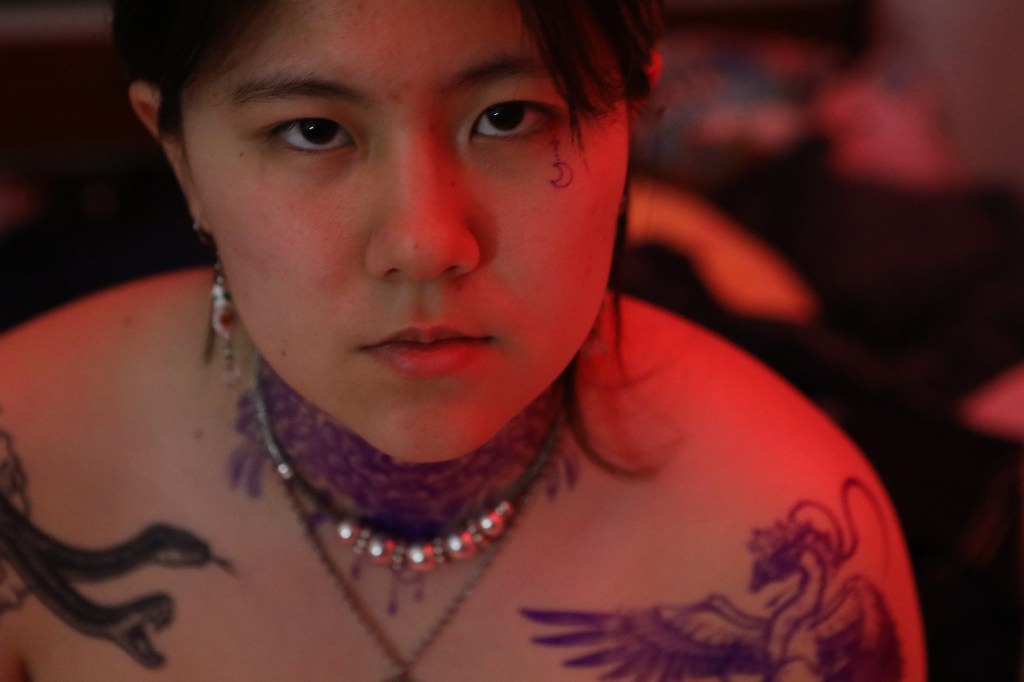
Iza’s body is an experiment. A figure plucked from the pages of a YA novel where the mystical protagonists carve spells into their skin, or the lyrics of a small, Brooklyn-based rock group’s top hit about their elusive dream girl (she’s aloof but sensitive, and very, very cool). More concretely, she’s a senior at Penn studying design and a self-taught tattoo artist who works out of her makeshift bedroom-studio. Iza took up inking during the summer of 2021, practicing on a few fruits, her (very trusting) friends, and herself, eventually working her way up to a semi-professional setup in the corner of her room. Iza isn’t the kind of person you forget meeting. Even if her name slips your mind, her dark hair, dark eyes, and the even darker marks etched into her skin burn into your memory.
She sticks out, even in an art history class populated by Penn’s most curtain-banged, vintage-clothed individuals. Her longboard—tall and stiff, with loose wheels—bobs above her head when she twists through rows of seats to find her spot in the back. She’s short, unassuming. Dark curtain bangs curl over her face, and the sleeves of a baggy t-shirt droop nearly to her elbows. We know of each other through mutual friends. She asks me to sign the attendance sheet for her when she skips class a few times, and I practice her signature on a scrap sheet of paper. Iza Hu, with pointed, jagged lines. Not Isabel. Iza. Sharp like a knife, or like a needle.
Sitting in Iza’s room feels like being swallowed by her, a shot of clairvoyant liquor chased with a splash of Soju. Bright photos paper the walls, a constellation of her own illustrations, favorite albums, and wispy Tumblr-core printouts, framing a low bed shoved into a corner, a crowded desk, and a full-length mirror. In the corner, her makeshift studio: a low faux-leather massage bed set against a wall plastered with illustrations, dark ink burning through the wafer-thin pages. It’s almost medical—a smooth plastic printer, clear tins of thick, opaque liquid, a needle-thin tattooing pen perched on a sterile rolling cart.
Iza hunches over the massage bed, watching Alyssa’s fingers carefully steady thick, tan-colored rubber. Alyssa Chandler is a junior, a year behind Iza, and she carves ruby-red stencils out of foam blocks for the Year of the Rabbit and the Save Chinatown Coalition. Alyssa and Iza feel like sister creations of the same artist who exclusively doodles cool Asian girls in the margins of their notebook. Alyssa has dyed-red hair, delicate hands, and wide, emphatic eyes. She speaks softly, almost imperceptibly, and a silver ring glistens from her septum. Iza sits broadly, smiles with the edges of her mouth, and shoves back thick, black hair. They first met on Hinge. Then at a party, then in a figure-painting class. Then now, on purpose, in Iza’s bedroom-studio.
Iza lays down her tattooing commandments: always shave the area beforehand. Hair is a complicating factor. Ensure your workspace is clean and well-lit. Atmosphere and visibility is key. Coat the skin with a thin layer of Vaseline. Gently spread the surface taut with your fingers, creating a path for your hand. Start slowly.
She gestures to Alyssa’s linework on the faux skin. “Look at the way you’re holding the pen. If you hold the pen this way, the ink will shoot that way. Make sure that you’re holding the pen in the direction that the ink is flowing.” Alyssa gently corrects her hands, following the curve of a small stencil Iza imprinted on the fleshy slab.
It’s her first time teaching someone else how to tattoo. Really, it’s her first time experiencing tattoo instruction—Iza is totally self-taught.
“I bought my first machine on AliExpress for 50 bucks,” she tells me. It’s a small, plastic red thing relegated to the corner of her desk that looks like a toy compared to her new instrument, a sleek black pen that softly vibrates in Alyssa’s hand. Shouldering her amalgamation of DIY tattooing Youtube videos and years as an illustrator, Iza started on substitute surfaces, taking trips to Chinatown to buy oranges and pig ears—she heard they were similar to real, human skin.
“Didn’t ever do that again,” she laughs. “[The pig ears] were so smelly, I was like, ‘I should just practice on myself.’ So I did.”
Her first self-ink is a small mark in the middle of her thigh. She shows me how it looks like an exclamation point if you’re facing her, but it looks like an “i” for “Iza” from her perspective. Her second is a cat on her ankle—she pulls up the cuff of her pants to show me. The lines are thick and a little blotchy, drawn with a shaky and gleeful hand.
Iza’s eyes flicker back to Alyssa, who draws whisker-thin parallel lines into the rubber. “Needle depth is something you have to kind of learn for yourself … don’t go too deep, and don’t go too light, because then you’ll only scratch the surface of your skin. You want to get right in the dermal part.”
It’s something that’s hard to emulate on the faux skin. Iza flips her arm to show a flowering tattoo that twists around the joint. Her fingers trace a clean line until they encounter a dark blotch that blooms from the intersection of two lines. “See? The artist went too deep and there’s a blowout here.”
Her method depends on where on the body she’s tattooing. “Your ass has more fat, so you would have to go deeper, versus your ankles, where the skin is so thin that you have to be really careful not to blow out. Like with yours,” she says, gesturing to my ribcage.
On a foggy weekend in February, I sprawl on Iza’s massage table with her bent over my side. The table was built for more Iza-sized people than Mira-sized people—my feet hang over the bottom edge, and I bend my knees, back, shoulders into a compact, tattoo-able body. My face presses into the corner of Iza’s room, below translucent sheets of flash stencils and full-back drafts. When I exhale sharply at the pain in my side, the pages flutter ever so slightly.
The vibrations of Iza’s tattoo pen, my first time, shake my skull behind closed eyelids, occasionally overlapping with the sound of her voice. “Does it hurt?” It does, sort of, but not the kind of excruciating pain I expected from a four-inch rib tattoo. The worst part is shading, the quick, back-and-forth pressure of stippling along my side that pinches and burns, raises the hairs on my spine, makes me grind my teeth together.
There’s hardly a more intimate act than coloring underneath someone’s skin. And Iza does it at least once every weekend. She flows through conversations like a well-practiced artist, first our art history class, then that bad date story we’re somehow both privy to, then that text from the guy I’ve just started seeing, then her design thesis, an homage to the art of tattooing and the conservative Chinese culture that raised her.
It only takes a few hours—dropping my backpack in the corner of her room, sinking into the comforter on the edge of her bed, looking over her shoulder as she sketches out a design on her iPad, printing the stencil on a small, black machine propped up next to the massage table, pulling up the hem of my shirt, pressing the stencil into my skin, and darkening my side with ink. And the saran-wrapped, blackened design eternally resides at the bend of my side.
A few weeks later, I shimmy my sweatshirt up above the imposing ink on my ribs in the kitchen of my childhood home. Glance expectantly at my mother peering at me through tortoiseshell reading glasses. Her response: “It’s big.”
I never really pinpointed when she shifted—when I was in middle school, she circled a spot on her wrist with her thumb and told my dad and I that she’d like to get a tattoo someday. Maybe a little tree. But some force within my parents, the remnant of boys’/girls’ Catholic schools, a general Gen-X conservative-ness, or a Southern-suburban paradoxical aversion to both change and permanence, pushed the possibility of tatted-up bodies from their minds.
A few weeks before Iza bore into my side, my younger sister went to a Friday the 13th flash tattoo event and left with the number “13” in an infinity sign stamped on her upper thigh. But of course, she never told our parents. So I shouldered my oldest-child duty and flashed my ribcage at the dinner table. When my mom texted our dad, “Mira got a tattoo,” he begrudgingly wrote back, “Ugh. Ok.”
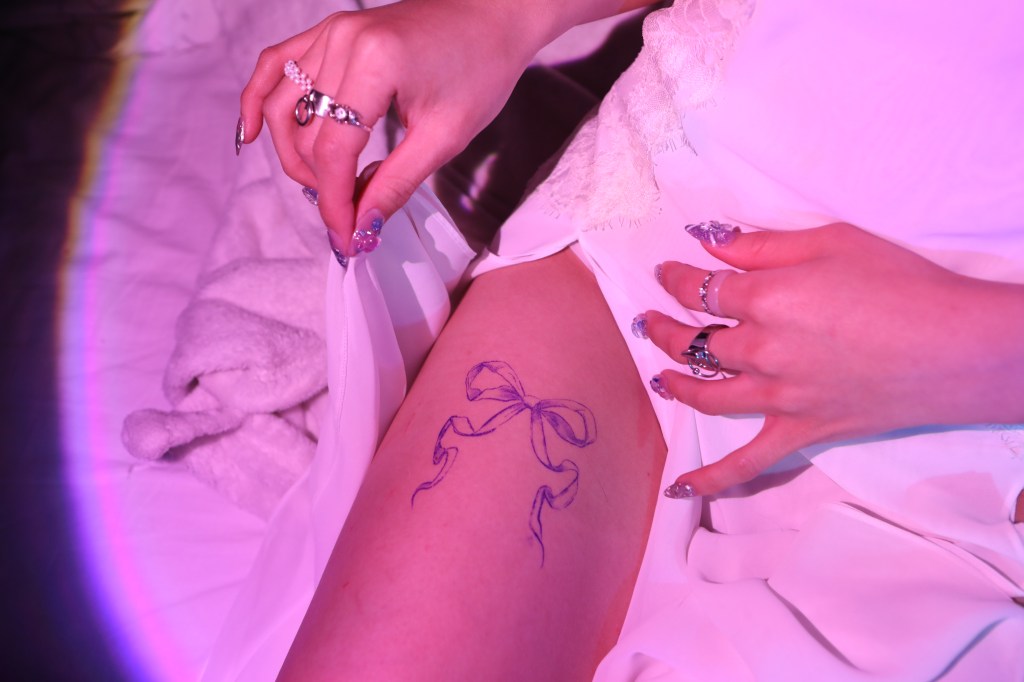
Above Alyssa’s head and scattered about my feet are purple stenciled designs that span two or three pages, cut and pasted together to form large arcs of ink. They’re the tattoos of Iza’s friends’ “wildest dreams,” part of her design thesis that focuses on body reclamation and the stigma surrounding tattoos in Chinese culture.
“I’m designing tattoos for them with no limit, whatever they want, stenciling it on them, and photographing them in a space that they feel most comfortable, most intimate, most private. Most of them are in their bedrooms.”
She rifles through a stack of papers on the floor next to the cutout stencils, spreading a set of saturated scenes: blacks and reds and satins and lace and violet ink silhouetted against pale skin and bone. Iza’s thesis is an ode to her identity, her history, her hands.
In the last photograph, Iza and Alyssa fix their eyes on their reflections in a mirror. Twin tigers consume their calf and bicep.
When Alyssa finishes dotting an untouched area of faux skin, she flexes her grip on the pen and turns to me. “Would you like to try?”
The pen is somehow bulky and light at once—the large grip tapers into a nearly invisible point. I dip the pen into the ink cap, watching the tip guzzle dark solution. Alyssa dabs some Vaseline from the side of her gloved hand onto the rubber skin. I press a button at the corner of Iza’s desk to turn the machine on, and it quivers in my hand like a heartbeat. Stretch skin with fingers, mark in strong, straight lines pointing towards myself. Quicker and more shallow to shade. It’s not unlike writing with a pen, but my output is glistening black and utterly volatile—my strokes collide and blur together.
Iza says the first step of being a good tattoo artist is being a good artist. The rest comes later. It’s easy for her to say—Iza’s a talented artist, but she’s also a risk-taker, a conversationalist, a skater, an unabashed fan of Lana del Rey. She’s in with the group of grad students who keep returning to sit around her room for new ink. The residents of the University City Townhomes come to her for matching tattoos to commemorate their shared struggle. An English major in her art history class asks her to engrave a caryatid, a column form they learned about in the first week together, into her ribcage, then asks if she can write about it. And with a sharp eye and steady hand, Iza stitches together the hundreds of bodies that go to work, class, the library, Trader Joe’s, church, Clark Park, and their homes with her art living and breathing underneath their skin.
 The Woodlands